
Geometric Twins
Figure It Out — Questions & Solutions
Think first. Use AI purposefully. Verify always.
Choose Try It Yourself to develop your reasoning, or View Solution to read the complete solution straight away.
Figure It Out · page 3 · Question 1
Printed page 3
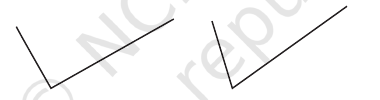
Check if the two figures are congruent.
AIMS worked solution
Given
Check congruence of the two bent, two-arm figures shown in the textbook.
To Find
Whether the two source angle figures are congruent
Reasoning
A rigid motion preserves both arm lengths and their included angle.
Solution
Align one arm and the joint of the two figures.
The other arm opens at a different angle in the source drawing, so it does not coincide.
Equal or similar arm lengths alone are insufficient.
Result
The two displayed figures are not congruent.
Compare the reasoning with your own work. Reading a solution does not record mastery.
Figure It Out · page 3 · Question 2
Printed page 3
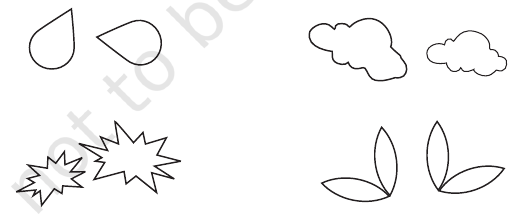
Circle the pairs that appear congruent.
AIMS worked solution
Given
Circle the source pairs that appear congruent: teardrops, clouds, starbursts and two-leaf figures.
To Find
Pairs that appear to have the same shape and size
Reasoning
Rotation and reflection are allowed; resizing is not.
Solution
The two teardrops can be matched by changing orientation
they appear congruent.
The two-leaf figures appear to match after reflection.
The clouds and starbursts have different sizes, so those pairs do not appear congruent.
The question asks about appearance.
For an exact physical check, trace and superimpose the outlines without stretching.
Result
Circle the teardrop pair and the two-leaf pair.
Compare the reasoning with your own work. Reading a solution does not record mastery.
Figure It Out · page 3 · Question 3
Printed page 3
What measurements would you take to create a figure congruent to a given:
(a) Circle
(b) Rectangle
Using this, state how would you check if two —
(a) Circles are congruent?
(b) Rectangles are congruent?
AIMS worked solution
Given
A circle or a rectangle to be copied.
To Find
Sufficient measurements for congruence
Property
A radius fixes a circle; two adjacent side lengths fix a rectangle.
Solution
For circles, compare radii.
For rectangles, compare the unordered pair of length and width
rotation may swap their orientation.
Area alone is insufficient: 2 × 6 and 3 × 4 have the same area but different dimensions.
Result
Use radius for a circle, and length and width for a rectangle.
Compare the reasoning with your own work. Reading a solution does not record mastery.
Figure It Out · page 4 · Question 4
Printed page 4
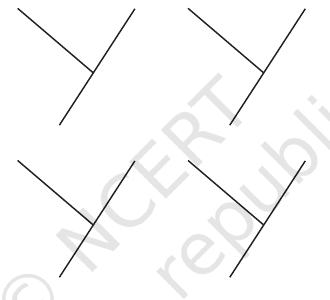
How would we check if two figures like the one below are congruent?
Use this to identify whether each of the following pairs are congruent.
AIMS worked solution
Given
State how to check congruence of the three-arm symbol, then assess the two source pairs.
To Find
Required measurements and congruence of both displayed pairs
Reasoning
Measure all arms from the junction and their relative angles.
Solution
Record the three arm lengths, the straight-line relation of the two opposite arms, and the angle of the third arm to a specified arm.
For each displayed pair, the second symbol is a translated copy of the first: the same endpoints and junction align after shifting.
Both pairs are congruent.
The stored source’s line geometry confirms this equality
no scale change is required.
Result
Both source pairs are congruent; arm lengths and angles establish the match.
Compare the reasoning with your own work. Reading a solution does not record mastery.
Figure It Out · page 8 · Question 1
Printed page 8
Suppose ∆HEN is congruent to ∆BIG. List all the other correct ways of expressing this congruence.
AIMS worked solution
Given
Given △HEN ≅ △BIG, list all other correctly ordered forms of this correspondence.
To Find
Equivalent triangle-order statements
Reasoning
Keep H↔B, E↔I and N↔G in matching positions.
Solution
Starting with each vertex and traversing either direction gives six orders in total.
Apart from HEN≅BIG, the remaining orders are HNE≅BGI, EHN≅IBG, ENH≅IGB, NHE≅GBI and NEH≅GIB.
Each equality can also be read with its two sides reversed
this does not create a different correspondence.
Result
△HNE≅△BGI; △EHN≅△IBG; △ENH≅△IGB; △NHE≅△GBI; △NEH≅△GIB.
Compare the reasoning with your own work. Reading a solution does not record mastery.
Figure It Out · page 8 · Question 2
Printed page 8
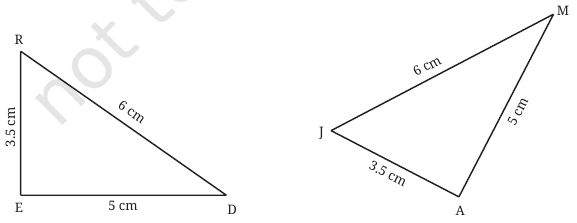
Determine whether the triangles are congruent. If yes, express the congruence.
AIMS worked solution
Given
RE = JA, ED = AM and RD = JM.
To Find
The congruence order
Property
SSS.
Solution
R is where the 3.5 cm and 6 cm sides meet
it matches J.
E matches A, and D matches M.
Result
△RED ≅ △JAM.
Compare the reasoning with your own work. Reading a solution does not record mastery.
Figure It Out · page 9 · Question 3
Printed page 9
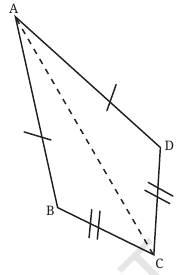
In the figure below, AB = AD, CB = CD.
Can you identify any pair of congruent triangles? If yes, explain why they are congruent.
Does AC divide ∠BAD and ∠BCD into two equal parts? Give reasons.
AIMS worked solution
Given
AB = AD, CB = CD and common side AC.
To Prove
∠BAC = ∠CAD and ∠BCA = ∠ACD
Property
SSS then corresponding angles.
Proof
AB = AD, BC = DC and AC = AC give △ABC ≅ △ADC.
A ↔ A, B ↔ D, C ↔ C.
The two angles adjacent to AC at A match
so do those at C.
Result
AC bisects both specified angles.
Compare the reasoning with your own work. Reading a solution does not record mastery.
Figure It Out · page 9 · Question 4
Printed page 9
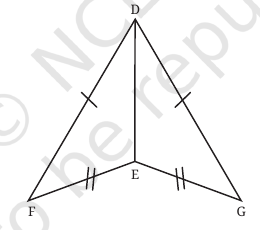
In the figure below, are ΔDFE and ΔGED congruent to each other? It is given that DF = DG and FE = GE.
AIMS worked solution
Given
DF = DG, FE = GE and common side DE.
To Find
The correctly ordered congruence
Property
SSS with D ↔ D, F ↔ G and E ↔ E.
Solution
DF corresponds to DG
FE corresponds to GE
DE corresponds to DE.
The correct statement is △DFE ≅ △DGE.
△DFE ≅ △GED would wrongly pair DF with GE, which is not guaranteed.
Result
The triangles are congruent, but △DFE ≅ △GED is not a justified order.
Compare the reasoning with your own work. Reading a solution does not record mastery.
Figure It Out · page 13 · Question 1
Printed page 13
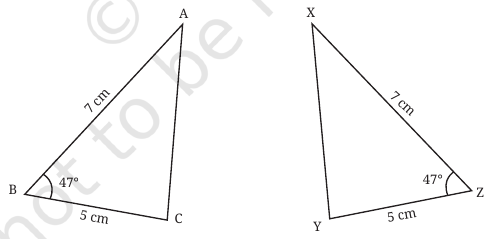
Identify whether the triangles below are congruent. What conditions did you use to establish their congruence? Express the congruence.
AIMS worked solution
Given
Two corresponding sides with the included angles B and Z.
To Find
The congruence order
Property
SAS.
Solution
B ↔ Z lies between the 7 cm and 5 cm sides.
A ↔ X and C ↔ Y.
Result
△ABC ≅ △XZY.
Compare the reasoning with your own work. Reading a solution does not record mastery.
Figure It Out · page 14 · Question 2
Printed page 14
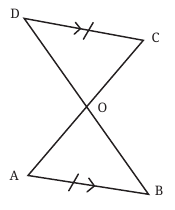
Given that CD and AB are parallel, and AB = CD, what are the other equal parts in this figure? (Hint: When the lines are parallel, the alternate angles are equal. Are the two resulting triangles congruent? If so, express the congruence.)
AIMS worked solution
Given
A,O,C and B,O,D are straight lines; AB ∥ CD and AB = CD.
To Find
Corresponding equal parts of the crossing triangles
Property
Alternate interior angles and ASA.
Solution
∠BAO = ∠DCO
∠ABO = ∠CDO.
AB = CD, so △ABO ≅ △CDO by ASA.
The correspondence is A ↔ C, B ↔ D, O ↔ O.
Result
AO = CO, BO = DO and ∠AOB = ∠COD.
Compare the reasoning with your own work. Reading a solution does not record mastery.
Figure It Out · page 14 · Question 3
Printed page 14
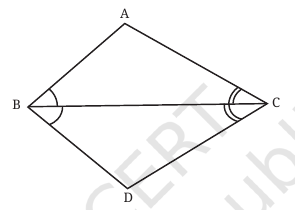
Given that ∠ABC = ∠DBC and ∠ACB = ∠DCB, show that ∠BAC = ∠BDC. Are the two triangles congruent?
AIMS worked solution
Given
The two angle pairs and common side BC.
To Prove
∠BAC = ∠BDC and △ABC ≅ △DBC
Property
Angle sum and ASA.
Proof
The third angles are each 180° minus the same two base angles.
The known angles have common included side BC.
Result
△ABC ≅ △DBC; the third angles are equal.
Compare the reasoning with your own work. Reading a solution does not record mastery.
Figure It Out · page 14 · Question 4
Printed page 14
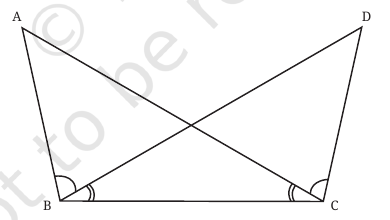
Identify the equal parts in the following figure, given that ∠ABD = ∠DCA and ∠ACB = ∠DBC.
AIMS worked solution
Given
B and C are the common base endpoints; the two given angle equalities.
To Find
The correspondence between △ABC and △DCB
Property
Angle addition followed by ASA.
Solution
∠ABC = ∠ABD + ∠DBC
∠DCB = ∠DCA + ∠ACB.
Hence ∠ABC = ∠DCB.
∠ACB = ∠DBC and BC = CB.
Thus △ABC ≅ △DCB.
Result
AB = DC, AC = DB and ∠BAC = ∠CDB.
Compare the reasoning with your own work. Reading a solution does not record mastery.
Figure It Out · page 20 · Question 1
Printed page 20
∆AIR ≅ ∆FLY. Identify the corresponding vertices, sides and angles.
AIMS worked solution
Given
Given △AIR ≅ △FLY, identify corresponding vertices, sides and angles.
To Find
The complete correspondence
Reasoning
The order of a congruence statement fixes corresponding positions.
Solution
Vertices: A↔F, I↔L, R↔Y.
Sides: AI = FL, IR = LY, RA = YF.
Angles: ∠IAR = ∠LFY, ∠AIR = ∠FLY, ∠IRA = ∠LYF.
Result
All three vertex, side and angle pairs follow the stated order.
Compare the reasoning with your own work. Reading a solution does not record mastery.
Figure It Out · page 20 · Question 2
Printed page 20
Each of the following cases contains certain measurements taken from two triangles. Identify the pairs in which the triangles are congruent to each other, with reason. Express the congruence whenever they are congruent.
(a) AB = DE; BC = EF; CA = DF
(b) AB = EF; ∠A = ∠E; AC = ED
(c) AB = DF; ∠B = ∠D = 90°; AC = FE
(d) ∠A = ∠D; ∠B = ∠E; AC = DF
(e) AB = DF; ∠B = ∠F; AC = DE
AIMS worked solution
Given
(a) AB = DE, BC = EF, CA = DF; (b) AB = EF, ∠A = ∠E, AC = ED; (c) AB = DF, ∠B = ∠D = 90°, AC = FE; (d) ∠A = ∠D, ∠B = ∠E, AC = DF; (e) AB = DF, ∠B = ∠F, AC = DE
To Find
Congruence criterion and valid order in cases (a)–(e)
Reasoning
Use only a sufficient criterion; SSA does not guarantee congruence.
Solution
(a) SSS: The endpoints of AB and AC give A ↔ D.
Then B ↔ E and C ↔ F. △ABC ≅ △DEF.
(b) SAS: The included angles A and E lie between the given side pairs
A ↔ E, B ↔ F, C ↔ D. △ABC ≅ △EFD.
(c) RHS: AC and FE are hypotenuses
the right-angle vertices B and D correspond.
AB ↔ FD gives A ↔ F and C ↔ E. △ABC ≅ △FDE.
(d) AAS: The third angles C and F agree by the angle sum, so AAS applies. △ABC ≅ △DEF.
(e) SSA — insufficient in general: The angle is not included between AB and AC, or between DF and DE.
The two-intersection construction is a counterexample.
No congruence guaranteed.
Result
(a) △ABC≅△DEF; (b) △ABC≅△EFD; (c) △ABC≅△FDE; (d) △ABC≅△DEF; (e) no guaranteed congruence.
Compare the reasoning with your own work. Reading a solution does not record mastery.
Figure It Out · page 20 · Question 3
Printed page 20
It is given that OB = OC, and OA = OD. Show that AB is parallel to CD.
[Hint: AD is a transversal for these two lines. Are there any equal alternate angles?]
AIMS worked solution
Given
A,O,D are collinear and B,O,C are collinear; O lies between the endpoints; OA = OD and OB = OC.
To Prove
AB ∥ CD
Property
SAS followed by the converse of the alternate-interior-angle property.
Proof
∠AOB = ∠DOC are vertically opposite angles.
OA = OD and OB = OC are given, so △AOB ≅ △DOC by SAS.
Corresponding angles ∠BAO and ∠CDO are equal.
These are alternate interior angles for AB and CD with transversal AD.
Result
AB ∥ CD. Also AB = DC by corresponding sides.
Compare the reasoning with your own work. Reading a solution does not record mastery.
Figure It Out · page 21 · Question 4
Printed page 21
ABCD is a square. Show that ∆ABC ≅ ∆ADC. Is ∆ABC also congruent to ∆CDA?
Give more examples of two triangles where one triangle is congruent to the other in two different ways, as in the case above.
Can you give an example of two triangles where one is congruent to the other in six different ways?
AIMS worked solution
Given
Square ABCD split along AC.
To Find
The valid correspondences and an example with six matches
Property
SSS; permutations must preserve every side length.
Solution
AB = AD, BC = DC and AC is common: △ABC ≅ △ADC.
AB = CD, BC = DA and AC = CA: △ABC ≅ △CDA.
The right-angle vertex B must match D, so these square halves have two matches, not six.
Take two equilateral triangles ABC and XYZ of the same side length.
Every vertex permutation preserves all side lengths.
With ABC fixed, valid orders are XYZ, XZY, YXZ, YZX, ZXY and ZYX.
Another pair with two matches is any two congruent non-equilateral isosceles triangles.
Match their apex vertices and either pair their base endpoints in order or interchange those endpoints.
Result
Two matches for the square halves; six for a pair of congruent equilateral triangles.
Compare the reasoning with your own work. Reading a solution does not record mastery.
Figure It Out · page 21 · Question 5
Printed page 21
Find ∠B and ∠C, if A is the centre of the circle.
AIMS worked solution
Given
A is the centre; B and C lie on the circle; ∠BAC = 120°.
To Find
The measures of ∠ABC and ∠ACB
Property
Equal radii, isosceles base angles and the triangle angle sum.
Solution
AB = AC because both are radii.
Therefore ∠ABC = ∠ACB.
Their sum is 180° − 120° = 60°, so each is 30°.
Result
∠ABC = ∠ACB = 30°. This uses the 120° interior central angle, not its reflex angle.
Compare the reasoning with your own work. Reading a solution does not record mastery.
Figure It Out · page 21 · Question 6
Printed page 21
Find the missing angles. As per the convention that we have been following, all line segments marked with a single ‘|’ are equal to each other and those marked with a double ‘|’ are equal to each other, etc.
Source figure audit — the final angle network
Printed page 21, Figure it Out Q6. M, N, O and P below name the source’s four unnamed interior points. The diagram is a schematic transcription, not an exact metric construction.
The source contains inconsistent data. Attempt local deductions from the marked information; an exact solution satisfying every mark is not possible.
Single, double and triple ticks preserve the source’s distinct equality groups. The 90° label at O is the printed angle NOP. The outer corner and altitude squares are the source’s right-angle marks.
AIMS worked solution
Given
Find the missing angles in the source angle network, respecting the groups of equal-length marks.
To Find
Valid local angle deductions and consistency of the full figure
Reasoning
Isosceles base angles, straight angles and triangle angle sums; distinguish local deductions from a globally exact construction.
Solution
The source data are not jointly exact: equal single-marked lengths give outer rectangle sides in ratio 3:2, whose diagonal makes arctan()≈33.69°, not exactly the printed 34°.
Accordingly, no globally consistent exact assignment satisfies all the source marks.
The following values are conditional local deductions, not a claim that the full network exists exactly.
M,N,O,P label the source’s unnamed interior points as in the accompanying diagram.
△CUR, angles in that vertex order: 90°, 45°, 45°.
CU = CR
angle C is right.
△AUN, angles in that vertex order: 56°, 68°, 56°.
AU = UN
use the angle sum.
△UMN, angles in that vertex order: 34°, 73°, 73°.
UM = UN
the two base angles share 146°.
△RVO, angles in that vertex order: 56°, 68°, 56°.
RV = VO
the two base angles share 112°.
△VOD, angles in that vertex order: 112°, 34°, 34°.
Straight line RVD gives 112° at V
VO = VD.
△DOF, angles in that vertex order: 56°, 26°, 98°.
Corner D is 90°
subtract 34°, then use the triangle sum.
△PFB, angles in that vertex order: 60°, 60°, 60°.
PF = FB = BP are double-marked.
△KLP, angles in that vertex order: 30°, 90°, 60°.
KL = LB and common perpendicular LP give △KLP ≅ △BLP by SAS
K,P,F are collinear.
△PLB, angles in that vertex order: 60°, 90°, 30°.
The equilateral angle at B leaves 30° in the right corner.
△NOP, angles in that vertex order: 34°, 90°, 56°.
Use the two given angles and the angle sum.
△ANK, angles in that vertex order: 34°, 44°, 102°.
Two printed angles give the third.
△NKP, angles in that vertex order: 102°, 48°, 30°.
AN and NO are opposite rays, so ∠KNO = 136°
subtract ∠PNO = 34°.
△PFO, angles in that vertex order: 94°, 22°, 64°. ∠OFB = 82° and ∠PFB = 60°
then use ∠NPO = 56° and ∠NPK = 30° with K,P,F collinear.
△MNO, angles in that vertex order: 83°, 51°, 46°.
At N: 180° − 56° − 73° = 51°
at O the printed angle is 46°.
△MRO, angles in that vertex order: 102°, 34°, 44°.
Two printed angles give the third.
△URM, angles in that vertex order: 33°, 45°, 102°.
At R on CRV: 180° − 45° − 34° − 56° = 45°
at U on CUA: 180° − 45° − 34° − 68° = 33°.
Result
Local deductions are listed with their assumptions; a corrected source figure is required for a globally exact solution.
Compare the reasoning with your own work. Reading a solution does not record mastery.