
Operations with Integers
Figure It Out — Questions & Solutions
Think first. Use AI purposefully. Verify always.
Choose Try It Yourself to develop your reasoning, or View Solution to read the complete solution straight away.
Figure It Out · page 25 · Parts (a)–(f)
Printed page 25
Let us try to find a few more pairs of numbers from their sums and differences:
(a) Sum = 27, Difference = 9
(b) Sum = 4, Difference = 12
(c) Sum = 0, Difference = 10
(d) Sum = 0, Difference = – 10
(e) Sum = – 7, Difference = – 1
(f) Sum = – 7, Difference = – 13 Choose a partner and take turns to play this game. In each turn, one of you can think of two integers, and give their sum and difference; the other person must then figure out the integers. After some practice, you can perform this magic trick for your family members and surprise them!
AIMS worked solution
Given
Find the ordered pair of integers for each sum and difference: (a) 27, 9; (b) 4, 12; (c) 0, 10; (d) 0, −10; (e) −7, −1; (f) −7, −13.
To Find
First and second integer in each pair
Reasoning
Apply the integer sign rules, order of operations and inverse operations.
Solution
If the numbers are x and y, add x+y = S and x−y = D to obtain 2x = S+D
then y = S−x.
(a) x = 36 ÷ 2 = 18
y = 9.
Check: 18+9 = 27 and 18−9 = 9.
(b) x = 16 ÷ 2 = 8
y = −4.
(c) x = 10 ÷ 2 = 5
y = −5.
(d) x = −10 ÷ 2 = −5
y = 5.
(e) x = −8 ÷ 2 = −4
y = −3.
(f) x = −20 ÷ 2 = −10
y = 3.
Check: −10+3 = −7 and −10−3 = −13.
Result
(a) ; (b) ; (c) ; (d) ; (e) ; (f) .
Compare the reasoning with your own work. Reading a solution does not record mastery.
Figure It Out · page 31 · Question 1
Printed page 31
Using the token interpretation, find the values of:
(a) 3 × (– 2)
(b) (– 5) × (– 2)
(c) (– 4) × (– 1)
(d) (– 7) × 3
AIMS worked solution
Given
Use tokens to evaluate (a) 3 × (−2), (b) (−5) × (−2), (c) (−4) × (−1), (d) (−7) × 3.
To Find
The four products
Reasoning
Apply the integer sign rules, order of operations and inverse operations.
Solution
(a) Add two negative tokens three times: −6.
(b) Removing two negative tokens five times has the same effect as adding ten positive tokens: 10.
Add zero pairs first if needed.
(c) Removing one negative token four times leaves value 4.
(d) Removing three positive tokens seven times leaves value −21.
Zero pairs allow removal without changing the starting value.
Result
(a) −6; (b) 10; (c) 4; (d) −21.
Compare the reasoning with your own work. Reading a solution does not record mastery.
Figure It Out · page 31 · Question 2
Printed page 31
If 123 × 456 = 56088, without calculating, find the value of:
(a) (– 123) × 456
(b) (– 123) × (– 456)
(c) (123) × (– 456)
AIMS worked solution
Given
Given 123 × 456 = 56088, evaluate (a) (−123) × 456, (b) (−123) × (−456), (c) 123 × (−456).
To Find
Signed products without repeating the long multiplication
Reasoning
Apply the integer sign rules, order of operations and inverse operations.
Solution
The magnitude remains 56088 in all three cases.
One negative factor makes (a) and (c) negative.
Two negative factors make (b) positive.
Result
(a) −56088; (b) 56088; (c) −56088.
Compare the reasoning with your own work. Reading a solution does not record mastery.
Figure It Out · page 31 · Question 3
Printed page 31
Try to frame a simple rule to multiply two integers.
AIMS worked solution
Given
Frame a simple rule for multiplying two integers.
To Find
A multiplication rule covering positive, negative and zero factors
Reasoning
Apply the integer sign rules, order of operations and inverse operations.
Solution
Multiply the magnitudes.
For two nonzero factors, give the result a positive sign when their signs match and a negative sign when they differ.
If either factor is zero, the product is zero.
Result
Same signs: positive; opposite signs: negative; a zero factor: zero.
Compare the reasoning with your own work. Reading a solution does not record mastery.
Figure It Out · page 33 · Parts (a)–(f)
Printed page 33
Find the following products.
(a) 4 × (– 3)
(b) (– 6) × (– 3)
(c) (– 5) × (– 1)
(d) (– 8) × 4
(e) (– 9) × 10
(f) 10 × (– 17)
AIMS worked solution
Given
Find (a) 4 × (−3), (b) (−6) × (−3), (c) (−5) × (−1), (d) (−8) × 4, (e) (−9) × 10, (f) 10 × (−17). Parts (c)–(f) continue on page 34.
To Find
The six products
Reasoning
Apply the integer sign rules, order of operations and inverse operations.
Solution
(a) Opposite signs: −(4 × 3) = −12.
(b) Same signs: 6 × 3 = 18.
(c) Same signs: 5 × 1 = 5.
(d) Opposite signs: −(8 × 4) = −32.
(e) −(9 × 10) = −90.
(f) −(10 × 17) = −170.
Result
(a) −12; (b) 18; (c) 5; (d) −32; (e) −90; (f) −170.
Compare the reasoning with your own work. Reading a solution does not record mastery.
Figure It Out · page 39 · Question 1
Printed page 39
Find the values of:
(a) 14 × (– 15)
(b) – 16 × (– 5)
(c) 36 ÷ (– 18)
(d) (– 46) ÷ (– 23)
AIMS worked solution
Given
Evaluate (a) 14 × (−15), (b) (−16) × (−5), (c) 36 ÷ (−18), (d) (−46) ÷ (−23).
To Find
The four values
Reasoning
Apply the integer sign rules, order of operations and inverse operations.
Solution
(a) −(14 × 15) = −210.
(b) 16 × 5 = 80.
(c) −(36 ÷ 18) = −2.
(d) 46 ÷ 23 = 2.
Result
(a) −210; (b) 80; (c) −2; (d) 2.
Compare the reasoning with your own work. Reading a solution does not record mastery.
Figure It Out · page 39 · Question 2
Printed page 39
A freezing process requires that the room temperature be lowered from 32°C at the rate of 5°C every hour. What will be the room temperature 10 hours after the process begins?
AIMS worked solution
Given
A room starts at 32°C and cools by 5°C each hour for 10 hours.
To Find
Room temperature after 10 hours
Reasoning
Apply the integer sign rules, order of operations and inverse operations.
Solution
The signed change is 10 × (−5) = −50°C.
Final temperature = 32+(−50) = −18°C.
Result
−18°C.
Compare the reasoning with your own work. Reading a solution does not record mastery.
Figure It Out · page 39 · Question 3
Printed page 39
A cement company earns a profit of ₹8 per bag of white cement sold and a loss of ₹5 per bag of grey cement sold. [Represent the profit/ loss as integers.]
(a) The company sells 3,000 bags of white cement and 5,000 bags of grey cement in a month. What is its profit or loss?
(b) If the number of bags of grey cement sold is 6,400 bags, what is the number of bags of white cement the company must sell to have neither profit nor loss.
AIMS worked solution
Given
White cement earns ₹8 per bag; grey cement loses ₹5 per bag. (a) Sell 3000 white and 5000 grey bags. (b) With 6400 grey bags, how many white bags give neither profit nor loss?
To Find
Net profit/loss in (a) and break-even white-bag count in (b)
Reasoning
Apply the integer sign rules, order of operations and inverse operations.
Solution
(a) Net = 3000 × 8+5000 × (−5) = 24000−25000 = −1000 rupees.
(b) Loss on grey bags = 6400 × 5 = 32000 rupees.
Let w be the white-bag count: 8w−32000 = 0.
Thus w = 32000 ÷ 8 = 4000 bags.
Result
(a) ₹1000 loss. (b) 4000 white bags.
Compare the reasoning with your own work. Reading a solution does not record mastery.
Figure It Out · page 39 · Question 4
Printed page 39
Replace the blank with an integer to make a true statement.
(a) (– 3) × _____ = 27
(b) 5 × _____ = (– 35)
(c) _____ × (– 8) = (– 56)
(d) _____ × (– 12) = 132
(e) _____ ÷ (– 8) = 7
(f) _____ ÷ 12 = – 11
AIMS worked solution
Given
Fill the blanks: (a) (−3) × □ = 27; (b) 5 × □ = −35; (c) □ × (−8) = −56; (d) □ × (−12) = 132; (e) □ ÷ (−8) = 7; (f) □ ÷ 12 = −11.
To Find
The missing integers
Reasoning
Apply the integer sign rules, order of operations and inverse operations.
Solution
(a) 27 ÷ (−3) = −9.
(b) −35 ÷ 5 = −7.
(c) −56 ÷ (−8) = 7.
(d) 132 ÷ (−12) = −11.
(e) 7 × (−8) = −56.
(f) −11 × 12 = −132.
Result
(a) −9; (b) −7; (c) 7; (d) −11; (e) −56; (f) −132.
Compare the reasoning with your own work. Reading a solution does not record mastery.
Figure It Out · page 42 · Question 1
Printed page 42
Find the values of the following expressions:
(a) (– 5) × (18 + (– 3))
(b) (– 7) × 4 × (– 1)
(c) (– 2) × (– 1) × (– 5) × (– 3)
AIMS worked solution
Given
Evaluate (a) (−5) × (18+(−3)), (b) (−7) × 4 × (−1), (c) (−2) × (−1) × (−5) × (−3).
To Find
The three expression values
Reasoning
Apply the integer sign rules, order of operations and inverse operations.
Solution
(a) First 18−3 = 15
then −5 × 15 = −75.
(b) −7 × 4 = −28
multiplying by −1 gives 28.
(c) Pair the negatives: 2 × 15 = 30.
Result
(a) −75; (b) 28; (c) 30.
Compare the reasoning with your own work. Reading a solution does not record mastery.
Figure It Out · page 42 · Question 2
Printed page 42
Find the values of the following expressions:
(a) (– 27) ÷ 9
(b) 84 ÷ (– 4)
(c) (– 56) ÷ (– 2)
AIMS worked solution
Given
Evaluate (a) (−27) ÷ 9, (b) 84 ÷ (−4), (c) (−56) ÷ (−2).
To Find
The three quotients
Reasoning
Apply the integer sign rules, order of operations and inverse operations.
Solution
(a) −(27 ÷ 9) = −3.
(b) −(84 ÷ 4) = −21.
(c) 56 ÷ 2 = 28.
Result
(a) −3; (b) −21; (c) 28.
Compare the reasoning with your own work. Reading a solution does not record mastery.
Figure It Out · page 42 · Question 3
Printed page 42
Find the integer whose product with (– 1) is:
(a) 27
(b) – 31
(c) – 1
(d) 1
(e) 0
AIMS worked solution
Given
Find the integer whose product with −1 is (a) 27, (b) −31, (c) −1, (d) 1, (e) 0.
To Find
The five original integers
Reasoning
Apply the integer sign rules, order of operations and inverse operations.
Solution
Multiplication by −1 takes the additive inverse, so negate each given result.
Check: (−27)(−1) = 27
31(−1) = −31
1(−1) = −1
(−1)(−1) = 1
0(−1) = 0.
Result
(a) −27; (b) 31; (c) 1; (d) −1; (e) 0.
Compare the reasoning with your own work. Reading a solution does not record mastery.
Figure It Out · page 42 · Question 4
Printed page 42
If 47 – 56 + 14 – 8 + 2 – 8 + 5 = – 4, then find the value of – 47 + 56 – 14 + 8 – 2 + 8 – 5 without calculating the full expression.
AIMS worked solution
Given
Given 47−56+14−8+2−8+5 = −4, find −47+56−14+8−2+8−5 without evaluating each term.
To Find
Value of the sign-reversed expression
Reasoning
Apply the integer sign rules, order of operations and inverse operations.
Solution
Every term is the opposite of its original term.
Factor out −1 from the entire new expression.
The new value is (−1) × (−4) = 4.
Result
4.
Compare the reasoning with your own work. Reading a solution does not record mastery.
Figure It Out · page 42 · Question 5
Printed page 42
Do you remember the Collatz Conjecture from last year? Try a modified version with integers. The rule is — start with any number; if the number is even, take half of it; if the number is odd, multiply it by – 3 and add 1; repeat. An example sequence is shown below. –7 22 11 32 –16 –8 –4 –2 –1 4 2 1
Try this with different starting numbers: (–21), (–6), and so on. Describe the patterns you observe.
AIMS worked solution
Given
Even n → n ÷ 2; odd n → (−3) × n + 1.
To Find
Investigate the three suggested starts without asserting a universal outcome.
Formula / Property / Theorem / Reasoning
Compute each signed step; repetition establishes a cycle for that particular sequence.
Solution
From −7: −7 → 22 → 11 → −32 → −16 → −8 → −4 → −2 → −1 → 4 → 2 → 1 → −2.
From −21: −21 → 64 → 32 → 16 → 8 → 4, then 2 → 1 → −2 → −1 → 4.
From −6: −6 → −3 → 10 → 5 → −14 → −7, then follow the first sequence.
These starts reach the cycle −2, −1, 4, 2, 1.
Testing examples is not a proof for all integer starts
0, for instance, stays 0.
Result
The three tested starts enter the same five-term cycle. No universal claim is made.
Compare the reasoning with your own work. Reading a solution does not record mastery.
Figure It Out · page 43 · Question 6
Printed page 43
In a test, (+ 4) marks are given for every correct answer and (– 2) marks are given for every incorrect answer.
(a) Anita answered all the questions in the test. She scored 40 marks even though 15 of her answers were correct. How many of her answers were incorrect? How many questions are in the test?
(b) Anil scored (– 10) marks even though he had 5 correct answers. How many of his answers were incorrect? Did he leave any questions unanswered?
AIMS worked solution
Given
A test awards +4 for each correct answer and −2 for each wrong answer. (a) Anita answers all questions, scores 40 and has 15 correct. (b) Anil scores −10 with 5 correct. Find wrong and unanswered counts.
To Find
Incorrect answers and total/unanswered questions
Reasoning
Apply the integer sign rules, order of operations and inverse operations.
Solution
(a) Correct answers earn 15 × 4 = 60.
The wrong answers contribute 40−60 = −20, so there are (−20) ÷ (−2) = 10 wrong answers.
Total questions: 15+10 = 25.
(b) Correct answers earn 5 × 4 = 20.
Wrong answers contribute −10−20 = −30, so there are 15 wrong answers.
Anil answered 5+15 = 20 of the same 25 questions, leaving 5 unanswered.
This uses the test convention that unanswered questions score zero.
Result
Anita: 10 wrong, 25 questions. Anil: 15 wrong, 5 unanswered.
Compare the reasoning with your own work. Reading a solution does not record mastery.
Figure It Out · page 43 · Question 7
Printed page 43
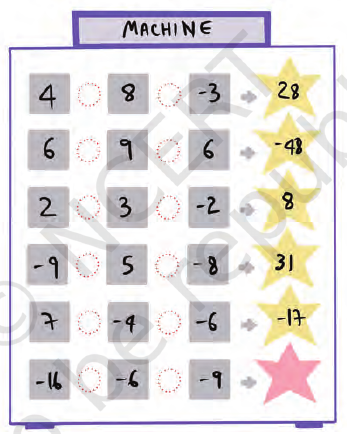
Pick the pattern — find the operations done by the machine shown below.
AIMS worked solution
Given
The machine maps (4,8,−3)→28, (6,9,6)→−48, (2,3,−2)→8, (−9,5,−8)→31 and (7,−4,−6)→−17. Find a matching rule and the output for (−16,−6,−9).
To Find
A rule fitting every displayed row and its missing output
Reasoning
Apply the integer sign rules, order of operations and inverse operations.
Solution
Try a−b × c, multiplying before subtracting.
4−8 × (−3) = 28
6−9 × 6 = −48
2−3 × (−2) = 8.
−9−5 × (−8) = 31 and 7−(−4) × (−6) = −17, so the rule fits all five rows.
For the last row, −16−(−6) × (−9) = −16−54 = −70.
Result
A matching rule is a−bc; missing output −70. Finite examples alone do not make a rule unique.
Compare the reasoning with your own work. Reading a solution does not record mastery.
Figure It Out · page 43 · Question 8
Printed page 43
Imagine you’re in a place where the temperature drops by 5°C each hour. If the temperature is currently at 8°C, write an expression which denotes the temperature after 4 hours.
AIMS worked solution
Given
The temperature starts at 8°C and drops 5°C per hour for 4 hours. Write an expression.
To Find
Expression for the final temperature
Reasoning
Apply the integer sign rules, order of operations and inverse operations.
Solution
Each hour contributes −5°C.
Four hours contribute 4 × (−5)°C.
The required expression is 8+4 × (−5)
its value is −12.
Result
8+4 × (−5) = −12°C.
Compare the reasoning with your own work. Reading a solution does not record mastery.
Figure It Out · page 43 · Question 9
Printed page 43
Find 3 consecutive numbers with a product of
(a) – 6,
(b) 120.
AIMS worked solution
Given
Find three consecutive integers with product (a) −6, (b) 120.
To Find
The consecutive-integer triples
Reasoning
Apply the integer sign rules, order of operations and inverse operations.
Solution
(a) (−3) × (−2) × (−1) = 6 × (−1) = −6.
(b) 4 × 5 × 6 = 20 × 6 = 120.
Result
(a) −3,−2,−1. (b) 4,5,6.
Compare the reasoning with your own work. Reading a solution does not record mastery.
Figure It Out · page 43 · Question 10
Printed page 43
An alien society uses a peculiar currency called ‘pibs’ with just two denominations of coins — a +13 pibs coin and a – 9 pibs coin. You have several of these coins. Is it possible to purchase an item that costs + 85 pibs?
Yes, we can use 10 coins of +13 pibs and 5 coins of – 9 pibs to make a total of + 85. Using the two denominations, try to get the following totals:
(a) + 20
(b) + 40
(c) – 50
(d) + 8
(e) + 10
(f) – 2
(g) + 1 [Hint: Writing down a few multiples of 13 and 9 can help.]
(h) Is it possible to purchase an item that costs 1568 pibs?
AIMS worked solution
Given
Coins are worth +13 or −9 pibs. Make +85 pibs, then the page-44 totals (a) 20, (b) 40, (c) −50, (d) 8, (e) 10, (f) −2, (g) 1, (h) 1568.
To Find
Non-negative coin counts for every requested total
Reasoning
Apply the integer sign rules, order of operations and inverse operations.
Solution
With x positive-value and y negative-value coins, the total is 13x−9y.
Counts must be non-negative integers.
Example: 13 × 10−9 × 5 = 85.
(a) 13 × 5−9 × 5 = 20.
(b) 13 × 10−9 × 10 = 40.
(c) 13 × 1−9 × 7 = −50.
(d) 13 × 2−9 × 2 = 8.
(e) 13 × 7−9 × 9 = 10.
(f) 13 × 4−9 × 6 = −2.
(g) 13 × 7−9 × 10 = 1.
(h) 13 × 122−9 × 2 = 1586−18 = 1568.
Result
Coin pairs : example ; (a) ; (b) ; (c) ; (d) ; (e) ; (f) ; (g) ; (h) . These are valid examples, not unique solutions.
Compare the reasoning with your own work. Reading a solution does not record mastery.
Figure It Out · page 44 · Question 11
Printed page 44
Find the values of:
(a) (32 × (– 18)) ÷ ((– 36))
(b) (32 ) ÷ ((– 36) × (– 18))
(c) (25 × (– 12)) ÷ ((45) × (– 27))
(d) (280 × (– 7)) ÷ ((– 8) × (– 35))
AIMS worked solution
Given
Evaluate (a) (32 × (−18)) ÷ (−36), (b) 32 ÷ ((−36) × (−18)), (c) (25 × (−12)) ÷ (45 × (−27)), (d) (280 × (−7)) ÷ ((−8) × (−35)).
To Find
The four exact quotients
Reasoning
Apply the integer sign rules, order of operations and inverse operations.
Solution
(a) −576 ÷ (−36) = 16.
(b) Denominator = 648, so = .
(c) Numerator = −300 and denominator = −1215.
Thus = .
(d) Numerator = −1960 and denominator = 280.
Thus = −7.
Result
(a) 16; (b) ; (c) ; (d) −7.
Compare the reasoning with your own work. Reading a solution does not record mastery.
Figure It Out · page 44 · Question 12
Printed page 44
Arrange the expressions given below in increasing order.
(a) (– 348) + (– 1064)
(b) (– 348) – (– 1064)
(c) 348 – (– 1064)
(d) (– 348) × (– 1064)
(e) 348 × (– 1064)
(f) 348 × 964
AIMS worked solution
Given
Arrange in increasing order: (a) (−348)+(−1064), (b) (−348)−(−1064), (c) 348−(−1064), (d) (−348) × (−1064), (e) 348 × (−1064), (f) 348 × 964.
To Find
Increasing order of the six labelled expressions
Reasoning
Apply the integer sign rules, order of operations and inverse operations.
Solution
Evaluate: (a) −1412
(b) 716
(c) 1412
(d) 370272
(e) −370272
(f) 335472.
The negative number with larger magnitude comes first
order the remaining positive numbers by magnitude.
Result
(e) < (a) < (b) < (c) < (f) < (d).
Compare the reasoning with your own work. Reading a solution does not record mastery.
Figure It Out · page 44 · Question 13
Printed page 44
Given that (– 548) × 972 = – 532656, write the values of:
(a) (– 547) × 972
(b) (– 548) × 971
(c) (– 547) × 971
AIMS worked solution
Given
Given (−548) × 972 = −532656, find (a) (−547) × 972, (b) (−548) × 971, (c) (−547) × 971.
To Find
The three neighbouring products
Reasoning
Apply the integer sign rules, order of operations and inverse operations.
Solution
(a) (−548+1) × 972 = −532656+972 = −531684.
(b) (−548) × (972−1) = −532656+548 = −532108.
(c) Use (a): (−547) × (972−1) = −531684+547 = −531137.
Result
(a) −531684; (b) −532108; (c) −531137.
Compare the reasoning with your own work. Reading a solution does not record mastery.
Figure It Out · page 44 · Question 14
Printed page 44
Given that 207 × (– 33 + 7) = – 5382, write the value of – 207 × (33 – 7) = _________.
AIMS worked solution
Given
Given 207 × (−33+7) = −5382, find −207 × (33−7).
To Find
Value of −207 × (33−7)
Reasoning
Apply the integer sign rules, order of operations and inverse operations.
Solution
Since −33+7 = −(33−7), the given expression is exactly −207 × (33−7).
Result
−5382.
Compare the reasoning with your own work. Reading a solution does not record mastery.
Figure It Out · page 44 · Question 15
Printed page 44
Use the numbers 3, – 2, 5, – 6 exactly once and the operations ‘+’, ‘–’, and ‘×’ exactly once and brackets as necessary to write an expression such that —
(a) the result is the maximum possible
(b) the result is the minimum possible
AIMS worked solution
Given
Four fixed signed numbers and three operations, each used exactly once; brackets allowed.
To Find
Find and verify the maximum and minimum.
Formula / Property / Theorem / Reasoning
Compare all valid orders and parenthesisations; do not insert an extra unary minus or reuse an operation.
Solution
(−6) × ((−2) − (5 + 3)) = (−6) × (−10) = 60.
((3 + 5) − (−2)) × (−6) = 10 × (−6) = −60.
A systematic complete check considers 24 number orders, 6 operation orders and 5 binary bracket structures: 720 expressions.
The five shapes are ((ab)c)d, (a(bc))d, (ab)(cd), a((bc)d), a(b(cd))
each adjacency stands for one of the three operations.
Exact integer evaluation of these cases gives no value outside −60 to 60.
Result
Maximum 60; minimum −60. The examples attain the bounds and the complete enumeration checks optimality.
Compare the reasoning with your own work. Reading a solution does not record mastery.
Figure It Out · page 44 · Question 16
Printed page 44
Fill in the blanks in at least 5 different ways with integers:
(a) □ + □ × □ = −36
(b) (□ − □) × □ = 12
(c) (□ − (□ − □)) = −1
AIMS worked solution
Given
Fill the boxes with integers in at least five ways: (a) □+□ × □ = −36; (b) (□−□) × □ = 12; (c) □−(□−□) = −1.
To Find
Five valid ordered triples of entries for each expression
Reasoning
Apply the integer sign rules, order of operations and inverse operations.
Solution
(a) Put the entries (−36−k,k,1), for k = 0,1,2,3,4: (−36,0,1), (−37,1,1), (−38,2,1), (−39,3,1), (−40,4,1).
Each gives −36−k+k = −36.
(b) Use (k+3,k,4), for k = 0,1,2,3,4: (3,0,4), (4,1,4), (5,2,4), (6,3,4), (7,4,4).
Each gives 3 × 4 = 12.
(c) Use (k,k+1,0), for k = 0,1,2,3,4: (0,1,0), (1,2,0), (2,3,0), (3,4,0), (4,5,0).
Each gives k−(k+1) = −1.
Result
Five verified fillings for each part; many others are possible.
Compare the reasoning with your own work. Reading a solution does not record mastery.