
The Baudhāyana–Pythagoras Theorem
Figure It Out — Questions & Solutions
Think first. Use AI purposefully. Verify always.
Choose Try It Yourself to develop your reasoning, or View Solution to read the complete solution straight away.
Figure It Out · page 39 · Question 1
Printed page 39
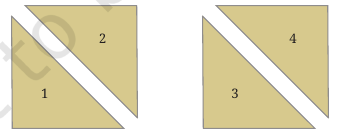
Earlier, we saw a method to create a square with double the area of a given square paper. There is another method to do this in which two identical square papers are cut in the following way. Can you arrange these pieces to create a square with double the area of either square?
AIMS worked solution
Four triangles, one new square
Given
Two identical squares are each cut along a diagonal into two triangular pieces. Arrange the four pieces into a square of twice the original area.
To Find
A square made from all four triangular pieces
Reasoning
Each piece is an isosceles right triangle with legs equal to the original side a.
Solution
Bring the four right-angle vertices together.
Place their equal legs along four perpendicular rays, with adjacent triangles sharing a leg.
The four hypotenuses form the outer boundary.
Each has the same length and each boundary angle is 45°+45° = 90°.
There is no overlap or gap: four triangles of area fill the new square.
Result
The assembled square has area 4 × = .
Compare the reasoning with your own work. Reading a solution does not record mastery.
Figure It Out · page 39 · Question 2
Printed page 39
The length of the two equal sides of an isosceles right triangle is given. Find the length of the hypotenuse. Find bounds on the length of the hypotenuse such that they have at least one digit after the decimal point.
(i) 3
(ii) 4
(iii) 6
(iv) 8
(v) 9
AIMS worked solution
Given
Find the hypotenuse of an isosceles right triangle with equal legs (i) 3, (ii) 4, (iii) 6, (iv) 8, (v) 9, and give decimal bounds.
To Find
Exact hypotenuses and strict one-decimal bounds
Reasoning
= , so c = a; compare squares of positive decimal endpoints.
Solution
(i) c = 3
4. = 17.64 < 18 < 18.49 = 4..
(ii) c = 4
5. = 31.36 < 32 < 32.49 = 5..
(iii) c = 6
8. = 70.56 < 72 < 72.25 = 8..
(iv) c = 8
11. = 127.69 < 128 < 129.96 = 11..
(v) c = 9
12. = 161.29 < 162 < 163.84 = 12..
Result
Respectively: 4.2 < c < 4.3; 5.6 < c < 5.7; 8.4 < c < 8.5; 11.3 < c < 11.4; 12.7 < c < 12.8. Exact values are 3,4,6,8,9.
Compare the reasoning with your own work. Reading a solution does not record mastery.
Figure It Out · page 47 · Question 1
Printed page 47
If a right-angled triangle has shorter sides of lengths 5 cm and 12 cm, then what is the length of its hypotenuse? First draw the right-angled triangle with these sidelengths and measure the hypotenuse, then check your answer using Baudhāyana’s Theorem.
AIMS worked solution
Given
Draw a right triangle with perpendicular sides 5 cm and 12 cm, measure its hypotenuse, then verify its length.
To Find
Hypotenuse length
Reasoning
Baudhāyana–Pythagoras theorem.
Solution
Draw AB = 12 cm, erect a perpendicular at A and mark AC = 5 cm.
Join B to C and measure BC.
= + = 144+25 = 169.
Since length is positive, BC = 13 cm.
Your drawing’s measurement should be close to 13 cm
measurement precision does not replace the exact calculation.
Result
13 cm.
Compare the reasoning with your own work. Reading a solution does not record mastery.
Figure It Out · page 47 · Question 2
Printed page 47
If a right-angled triangle has a short side of length 8 cm and hypotenuse of length 17 cm, what is the length of the third side? Again, try drawing the triangle and measuring, and then check your answer using Baudhāyana’s Theorem.
AIMS worked solution
Given
Draw a right triangle with a leg 8 cm and hypotenuse 17 cm, measure the third side, then verify it.
To Find
The other leg length
Reasoning
The squared leg is hypotenuse squared minus the known leg squared.
Solution
Draw AB = 8 cm and a perpendicular ray at A.
The circle centred at B with radius 17 cm meets the ray at C.
= − = 289−64 = 225
AC = 15 cm.
A careful drawing should measure approximately 15 cm.
Result
15 cm.
Compare the reasoning with your own work. Reading a solution does not record mastery.
Figure It Out · page 47 · Question 3
Printed page 47
Using the constructions you have now seen, how would you construct a square whose area is triple the area of a given square? Five times the area of a given square? (Baudhāyana’s Śulba-Sūtra, Verse 1.10)
AIMS worked solution
Given
Construct squares whose areas are three times and five times the area of a given square.
To Find
Constructed squares of areas 3A and 5A
Reasoning
A right triangle combines two square areas: + = .
Solution
Let the original side be s and its area A = .
Its diagonal d satisfies = 2A.
Construct perpendicular legs s and d
their hypotenuse h satisfies = A+2A = 3A.
Construct a square on h.
For five times the area, construct perpendicular legs s and 2s.
Their hypotenuse k satisfies = A+4A = 5A.
Construct a square on k.
Result
Required square sides are s and s.
Compare the reasoning with your own work. Reading a solution does not record mastery.
Figure It Out · page 47 · Question 4
Printed page 47
Let a, b and c denote the length of the sides of a right triangle, with c being the length of the hypotenuse. Find the missing sidelength in each of the following cases:
(i) a = 5, b = 7
(ii) a = 8, b = 12
(iii) a = 9, c = 15
(iv) a = 7, b = 12
(v) a = 1.5, b = 3.5
AIMS worked solution
Given
In a right triangle with legs a,b and hypotenuse c, find the missing side: (i) a = 5,b = 7; (ii) a = 8,b = 12; (iii) a = 9,c = 15; (iv) a = 7,b = 12; (v) a = 1.5,b = 3.5.
To Find
Five exact missing lengths
Reasoning
Use = + or = − as appropriate.
Solution
(i) = 25+49 = 74, so c = .
(ii) = 64+144 = 208, so c = 4.
(iii) = 225−81 = 144, so b = 12.
(iv) = 49+144 = 193, so c = .
(v) = 2.25+12.25 = 14.5 = , so c = .
Result
; 4; 12; ; , respectively.
Compare the reasoning with your own work. Reading a solution does not record mastery.
Figure It Out · page 50 · Question 1
Printed page 50
Find 5 more Baudhāyana triples using this idea.
AIMS worked solution
Given
Using odd squares as in the source, find five further Baudhāyana triples after (3,4,5) and (5,12,13).
To Find
Five further triples
Reasoning
For odd m ≥ 3, n = gives (n−1)+ = .
Solution
Use m = 7,9,11,13,15, giving n = 25,41,61,85,113.
The triples are (24,7,25), (40,9,41), (60,11,61), (84,13,85), (112,15,113).
Checks: 576+49 = 625
1600+81 = 1681
3600+121 = 3721
7056+169 = 7225
12544+225 = 12769.
Result
All five triples satisfy the squared equality.
Compare the reasoning with your own work. Reading a solution does not record mastery.
Figure It Out · page 50 · Question 2
Printed page 50
Does this method yield non-primitive Baudhāyana triples? [Hint: Observe that among the triples generated, one of the smaller sidelengths is one less than the hypotenuse.]
AIMS worked solution
Given
Can the odd-square generator produce a non-primitive Baudhāyana triple?
To Find
Whether any generated triple has a common divisor greater than 1
Reasoning
A divisor common to consecutive integers divides their difference 1.
Solution
The generated triple contains n−1 and n.
Any common divisor of all three entries would divide both n−1 and n, hence divide 1.
Therefore the greatest common divisor is 1 for every generated positive triple.
Result
No. Every triple from this generator is primitive.
Compare the reasoning with your own work. Reading a solution does not record mastery.
Figure It Out · page 50 · Question 3
Printed page 50
Are there primitive triples that cannot be obtained through this method? If yes, give examples.
AIMS worked solution
Given
Are there primitive triples not obtained by this odd-square method? Give an example.
To Find
A primitive triple outside the generator
Reasoning
Every generated triple has a leg exactly one less than its hypotenuse.
Solution
+ = 64+225 = 289 =
gcd(8,15,17) = 1.
Neither leg is 16, so (8,15,17) cannot be of the form (n−1,m,n).
Result
Yes: (8,15,17).
Compare the reasoning with your own work. Reading a solution does not record mastery.
Figure It Out · page 52 · Question 1
Printed page 52
Find the diagonal of a square with sidelength 5 cm.
AIMS worked solution
Given
Find the diagonal of a square of side 5 cm.
To Find
Square diagonal length
Reasoning
The diagonal is the hypotenuse of a right triangle with two legs of 5 cm.
Solution
= + = 50.
d = = 5 cm.
Result
5 cm.
Compare the reasoning with your own work. Reading a solution does not record mastery.
Figure It Out · page 52 · Question 2
Printed page 52
Find the missing sidelengths in the following right triangles:
Page 53 — figure 1
Page 53 — figure 2
Page 53 — figure 3
Page 53 — figure 4
Page 53 — figure 5
Page 53 — figure 6
AIMS worked solution
Given
Find the six missing side lengths in the right-triangle figures continuing on page 53, in reading order.
To Find
The six positive missing side lengths
Reasoning
Use the right-angle marks to identify legs and hypotenuses.
Solution
(i) Legs 7 and 9: = 49+81 = 130, so c = .
(ii) Legs 4 and 10 meet at the marked right angle: = 16+100 = 116, so c = 2.
(iii) Hypotenuse 41, leg 40: = 1681−1600 = 81, so b = 9.
(iv) Hypotenuse , leg 10: = 200−100 = 100, so b = 10.
(v) Legs 10 and : = 100+150 = 250, so c = 5.
(vi) Hypotenuse 45, leg 27: = 2025−729 = 1296, so b = 36.
Result
; 2; 9; 10; 5; 36.
Compare the reasoning with your own work. Reading a solution does not record mastery.
Figure It Out · page 53 · Question 3
Printed page 53
Find the sidelength of a rhombus whose diagonals are of length 24 units and 70 units.
AIMS worked solution
Rhombus half-diagonals
Schematic, not to scale. Diagonals bisect at right angles; each side is √(12²+35²)=37.
Given
Find the side of a rhombus with diagonals 24 units and 70 units.
To Find
Length of each rhombus side
Reasoning
Rhombus diagonals bisect one another at right angles.
Solution
Half-diagonals are 12 and 35.
Each side is a hypotenuse with these legs.
= + = 144+1225 = 1369
s = 37.
Result
37 units.
Compare the reasoning with your own work. Reading a solution does not record mastery.
Figure It Out · page 53 · Question 4
Printed page 53
Is the hypotenuse the longest side of a right triangle? Justify your answer.
AIMS worked solution
Given
Is the hypotenuse always the longest side of a right triangle? Justify.
To Find
Comparison of the hypotenuse with both legs
Reasoning
The legs a,b are positive and = +.
Solution
Since > 0, > , so c > a.
Since > 0, > , so c > b.
Positive square roots preserve these inequalities.
Result
Yes: the hypotenuse is strictly longer than either leg.
Compare the reasoning with your own work. Reading a solution does not record mastery.
Figure It Out · page 53 · Question 5
Printed page 53
True or False — Every Baudhāyana triple is either a primitive triple or a scaled version of a primitive triple.
AIMS worked solution
Given
True or false: every Baudhāyana triple is primitive or a scaled version of a primitive triple.
To Find
Truth and justification of the primitive-reduction statement
Reasoning
Divide a positive integer triple by its greatest common divisor.
Solution
Let g = gcd(a,b,c).
If g = 1, the triple is primitive.
If g > 1, write a = gA,b = gB,c = gC.
The numbers A,B,C are positive integers with gcd 1.
Dividing + = by gives + = .
Thus (A,B,C) is primitive and the original triple is its scale-g version.
Result
True.
Compare the reasoning with your own work. Reading a solution does not record mastery.
Figure It Out · page 53 · Question 6
Printed page 53
Give 5 examples of rectangles whose sidelengths and diagonals are all integers.
AIMS worked solution
Given
Give five rectangles with integer side lengths and integer diagonals.
To Find
Five verified integer rectangles
Reasoning
A rectangle diagonal satisfies = +.
Solution
Sides 3,4 give d = 5: 9+16 = 25.
Sides 5,12 give d = 13: 25+144 = 169.
Sides 8,15 give d = 17: 64+225 = 289.
Sides 7,24 give d = 25: 49+576 = 625.
Sides 12,35 give d = 37: 144+1225 = 1369.
Result
Rectangles 3 × 4, 5 × 12, 8 × 15, 7 × 24 and 12 × 35 satisfy the requirement.
Compare the reasoning with your own work. Reading a solution does not record mastery.
Figure It Out · page 53 · Question 7
Printed page 53
Construct a square whose area is equal to the difference of the areas of squares of sidelengths 5 units and 7 units.
AIMS worked solution
Construct the required square
Draw AB = 5 horizontally and the perpendicular at B. A circle centred at A with radius 7 intersects it at C. Construct a square on BC; its area is 24.
Given
Squares of sides 7 and 5 units.
To Find
A square of area − and its exact side
Property
Construction: draw AB = 5. At B draw a perpendicular; intersect it at C with the radius-7 circle centred at A.
Solution
AC = 7 and ∠ABC = 90° by construction.
= − = 49−25 = 24.
Construct a square on BC.
Its area is 24.
BC = = 2.
Result
Required side = 2 units; area = 24 square units.
Compare the reasoning with your own work. Reading a solution does not record mastery.
Figure It Out · page 53 · Question 8
Printed page 53
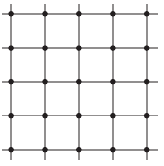
(i) Using the dots of a grid as the vertices, can you create a square that has an area of (a) 2 sq. units, (b) 3 sq. units, (c) 4 sq.units, and (d) 5 sq. unit?
(ii) Suppose the grid extends indefinitely. What are the possible integer-valued areas of squares you can create in this manner?
AIMS worked solution
Build a square on grid points
Area = + = 2 square units. Perpendicular side steps: and (-1,1).
Area 3 is impossible: both integer step magnitudes would be at most 1, whose squared sum is at most 2.
Given
An unlimited unit lattice; every vertex must have integer coordinates.
To Find
Possible areas, including 2,3,4,5
Property
For integers p,q not both zero, perpendicular equal side vectors are and .
Solution
Vertices ,,(p−q,p+q), form a square of area +.
Area 2: use = .
Area 4: .
Area 5: .
For area 3, |p| and |q| can only be 0 or 1
their squared sum is at most 2.
Thus 3 is impossible.
Every lattice square has an integer side vector, so the condition is necessary as well as sufficient.
Result
Exactly the positive integers expressible as a sum of two integer squares occur.
Compare the reasoning with your own work. Reading a solution does not record mastery.
Figure It Out · page 54 · Question 9
Printed page 54
Find the area of an equilateral triangle with sidelength 6 units. [Hint: Show that an altitude bisects the opposite side. Use this to find the height.]
AIMS worked solution
Altitude of an equilateral triangle
RHS congruence proves BD = DC before assigning the half-base lengths.
Given
Equilateral △ABC with each side 6; altitude AD to BC.
To Find
Area of △ABC
Property
RHS congruence, the Baudhāyana–Pythagoras theorem and triangle area.
Solution
△ADB≅△ADC by RHS: equal hypotenuses AB = AC, common AD and right angles at D.
Thus BD = DC = 3.
= − = 27, so AD = 3.
Area = .
Result
Area = 9 square units.
Compare the reasoning with your own work. Reading a solution does not record mastery.