
CBSE MATHEMATICS • SELECTED CENTRAL & STATE COMPETITIVE EXAMS
AIMSSchool of MathematicsAim through AIMS

Orienting Yourself: The Use of Coordinates

Textbook Exercises & Solutions

Think first. Use AI purposefully. Verify always.

Choose Try It Yourself to develop your reasoning, or View Solution to read the complete solution straight away.

Starred textbook questions are collected separately in ★ AIMS Think+.

Exercise Set 1.1(i)

Printed page 5

TEXTBOOK REFERENCE · GANITA MANJARI

Exercise Set 1.1(i) · Open official source ↗

Fig. 1.3 shows Reiaan’s room with points OABC marking its corners. The x- and y-axes are marked in the figure. Point O is the origin.

Referring to Fig. 1.3, answer the following questions:

(i) If D1R1 represents the door to Reiaan’s room, how far is the door from the left wall (the y-axis) of the room? How far is the door from the x-axis?
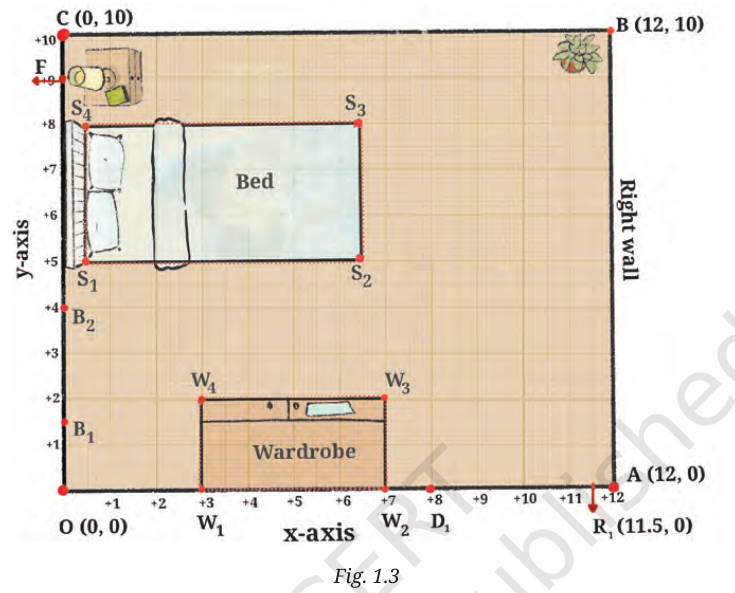
Original coordinate room plan with axes, grid, furniture, doorway and vertex labels, in feet.
Fig. 1.3 · NCERT, supplied chapter source. Numerical and figure qualifications are stated in the solution.

Textbook completion: not tracked yet. Your written response stays in this page’s current session.
Exercise Set 1.1(ii)

Printed page 5

TEXTBOOK REFERENCE · GANITA MANJARI

Exercise Set 1.1(ii) · Open official source ↗

Fig. 1.3 shows Reiaan’s room with points OABC marking its corners. The x- and y-axes are marked in the figure. Point O is the origin.

Referring to Fig. 1.3, answer the following questions:

(ii) What are the coordinates of D1?

Original coordinate room plan with axes, grid, furniture, doorway and vertex labels, in feet.
Fig. 1.3 · NCERT, supplied chapter source. Numerical and figure qualifications are stated in the solution.

Textbook completion: not tracked yet. Your written response stays in this page’s current session.

Exercise Set 1.1(iii)

Printed page 5

TEXTBOOK REFERENCE · GANITA MANJARI

Exercise Set 1.1(iii) · Open official source ↗

Fig. 1.3 shows Reiaan’s room with points OABC marking its corners. The x- and y-axes are marked in the figure. Point O is the origin.

Referring to Fig. 1.3, answer the following questions:

(iii) If R1 is the point (11.5,0), how wide is the door? Do you think this is a comfortable width for the room door? If a person in a wheelchair wants to enter the room, will heshe be able to do so easily?

Original coordinate room plan with axes, grid, furniture, doorway and vertex labels, in feet.
Fig. 1.3 · NCERT, supplied chapter source. Numerical and figure qualifications are stated in the solution.

Textbook completion: not tracked yet. Your written response stays in this page’s current session.

Exercise Set 1.1(iv)

Printed page 5

TEXTBOOK REFERENCE · GANITA MANJARI

Exercise Set 1.1(iv) · Open official source ↗

Fig. 1.3 shows Reiaan’s room with points OABC marking its corners. The x- and y-axes are marked in the figure. Point O is the origin.

Referring to Fig. 1.3, answer the following questions:

(iv) If B1 (0,1.5) and B2 (0,4) represent the ends of the bathroom door, is the bathroom door narrower or wider than the room door?

Original coordinate room plan with axes, grid, furniture, doorway and vertex labels, in feet.
Fig. 1.3 · NCERT, supplied chapter source. Numerical and figure qualifications are stated in the solution.

Textbook completion: not tracked yet. Your written response stays in this page’s current session.

Exercise Set 1.2 · Q1

Printed page 8

TEXTBOOK REFERENCE · GANITA MANJARI

Exercise Set 1.2 · Q1 · Open official source ↗

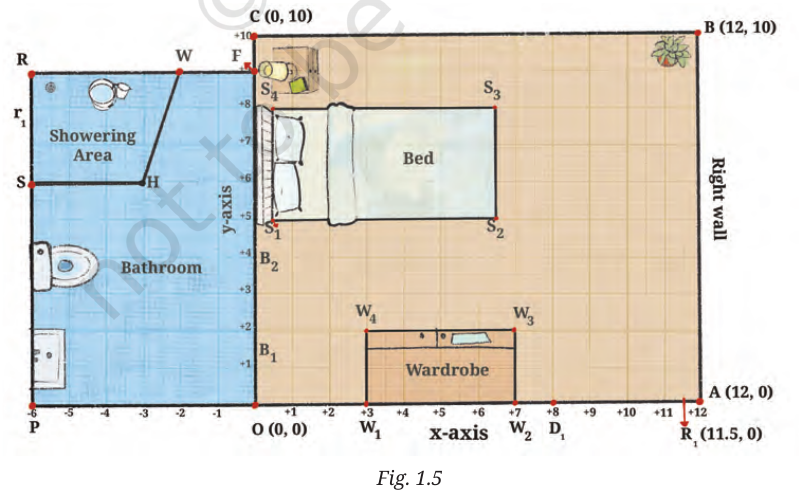
On a graph sheet, mark the x-axis and y-axis and the origin O. Mark points from (−7,0) to (13,0) on the x-axis and from (0,−15) to (0,12) on the y-axis. (Use the scale 1 cm = 1 unit.) Using Fig. 1.5, answer the given questions.

Place Reiaan’s rectangular study table with three of its feet at the points (8,9), (11,9) and (11,7).

(i) Where will the fourth foot of the table be?

(ii) Is this a good spot for the table?

(iii) What is the width of the table? The length? Can you make out the height of the table?

Original coordinate room plan with axes, grid, furniture, doorway and vertex labels, in feet.
Fig. 1.5 · NCERT, supplied chapter source. Numerical and figure qualifications are stated in the solution.

Textbook completion: not tracked yet. Your written response stays in this page’s current session.

Exercise Set 1.2 · Q2

Printed page 8

TEXTBOOK REFERENCE · GANITA MANJARI

Exercise Set 1.2 · Q2 · Open official source ↗

On a graph sheet, mark the x-axis and y-axis and the origin O. Mark points from (−7,0) to (13,0) on the x-axis and from (0,−15) to (0,12) on the y-axis. (Use the scale 1 cm = 1 unit.) Using Fig. 1.5, answer the given questions.

If the bathroom door has a hinge at B1 and opens into the bedroom, will it hit the wardrobe? Are there any changes you would suggest if the door is made wider?

Original coordinate room plan with axes, grid, furniture, doorway and vertex labels, in feet.
Fig. 1.5 · NCERT, supplied chapter source. Numerical and figure qualifications are stated in the solution.

Textbook completion: not tracked yet. Your written response stays in this page’s current session.

Exercise Set 1.2 · Q3(i)

Printed page 8

TEXTBOOK REFERENCE · GANITA MANJARI

Exercise Set 1.2 · Q3(i) · Open official source ↗

On a graph sheet, mark the x-axis and y-axis and the origin O. Mark points from (−7,0) to (13,0) on the x-axis and from (0,−15) to (0,12) on the y-axis. (Use the scale 1 cm = 1 unit.) Using Fig. 1.5, answer the given questions.

Look at Reiaan’s bathroom.

(i) What are the coordinates of the four corners O, F, R, and P of the bathroom?

Original coordinate room plan with axes, grid, furniture, doorway and vertex labels, in feet.
Fig. 1.5 · NCERT, supplied chapter source. Numerical and figure qualifications are stated in the solution.

Textbook completion: not tracked yet. Your written response stays in this page’s current session.

Exercise Set 1.2 · Q3(ii)

Printed page 8

TEXTBOOK REFERENCE · GANITA MANJARI

Exercise Set 1.2 · Q3(ii) · Open official source ↗

On a graph sheet, mark the x-axis and y-axis and the origin O. Mark points from (−7,0) to (13,0) on the x-axis and from (0,−15) to (0,12) on the y-axis. (Use the scale 1 cm = 1 unit.) Using Fig. 1.5, answer the given questions.

Look at Reiaan’s bathroom.

(ii) What is the shape of the showering area SHWR in Reiaan’s bathroom? Write the coordinates of the four corners.

Original coordinate room plan with axes, grid, furniture, doorway and vertex labels, in feet.
Fig. 1.5 · NCERT, supplied chapter source. Numerical and figure qualifications are stated in the solution.

Textbook completion: not tracked yet. Your written response stays in this page’s current session.

Exercise Set 1.2 · Q3(iii)

Printed page 8

TEXTBOOK REFERENCE · GANITA MANJARI

Exercise Set 1.2 · Q3(iii) · Open official source ↗

On a graph sheet, mark the x-axis and y-axis and the origin O. Mark points from (−7,0) to (13,0) on the x-axis and from (0,−15) to (0,12) on the y-axis. (Use the scale 1 cm = 1 unit.) Using Fig. 1.5, answer the given questions.

Look at Reiaan’s bathroom.

(iii) Mark off a 3 ft × 2 ft space for the washbasin and a 2 ft × 3 ft space for the toilet. Write the coordinates of the corners of these spaces.

Original coordinate room plan with axes, grid, furniture, doorway and vertex labels, in feet.
Fig. 1.5 · NCERT, supplied chapter source. Numerical and figure qualifications are stated in the solution.

Textbook completion: not tracked yet. Your written response stays in this page’s current session.

Exercise Set 1.2 · Q4(i)

Printed page 8

TEXTBOOK REFERENCE · GANITA MANJARI

Exercise Set 1.2 · Q4(i) · Open official source ↗

On a graph sheet, mark the x-axis and y-axis and the origin O. Mark points from (−7,0) to (13,0) on the x-axis and from (0,−15) to (0,12) on the y-axis. (Use the scale 1 cm = 1 unit.) Using Fig. 1.5, answer the given questions.

Other rooms in the house:

(i) Reiaan’s room door leads from the dining room which has the length 18 ft and width 15 ft. The length of the dining room extends from point P to point A. Sketch the dining room and mark the coordinates of its corners.

Original coordinate room plan with axes, grid, furniture, doorway and vertex labels, in feet.
Fig. 1.5 · NCERT, supplied chapter source. Numerical and figure qualifications are stated in the solution.

Textbook completion: not tracked yet. Your written response stays in this page’s current session.

Exercise Set 1.2 · Q4(ii)

Printed page 8

TEXTBOOK REFERENCE · GANITA MANJARI

Exercise Set 1.2 · Q4(ii) · Open official source ↗

On a graph sheet, mark the x-axis and y-axis and the origin O. Mark points from (−7,0) to (13,0) on the x-axis and from (0,−15) to (0,12) on the y-axis. (Use the scale 1 cm = 1 unit.) Using Fig. 1.5, answer the given questions.

Other rooms in the house:

Context from part (i): Reiaan’s room door leads from the dining room which has the length 18 ft and width 15 ft. The length of the dining room extends from point P to point A.

(ii) Place a rectangular 5 ft × 3 ft dining table precisely in the centre of the dining room. Write down the coordinates of the feet of the table.

Original coordinate room plan with axes, grid, furniture, doorway and vertex labels, in feet.
Fig. 1.5 · NCERT, supplied chapter source. Numerical and figure qualifications are stated in the solution.

Textbook completion: not tracked yet. Your written response stays in this page’s current session.

End-of-Chapter Q1

Printed page 12

TEXTBOOK REFERENCE · GANITA MANJARI

End-of-Chapter Q1 · Open official source ↗

What are the x-coordinate and y-coordinate of the point of intersection of the two axes?

Textbook completion: not tracked yet. Your written response stays in this page’s current session.

End-of-Chapter Q2

Printed page 12

TEXTBOOK REFERENCE · GANITA MANJARI

End-of-Chapter Q2 · Open official source ↗

Point W has x-coordinate equal to −5. Can you predict the coordinates of point H which is on the line through W parallel to the y-axis? Which quadrants can H lie in?

Textbook completion: not tracked yet. Your written response stays in this page’s current session.

End-of-Chapter Q3

Printed page 12

TEXTBOOK REFERENCE · GANITA MANJARI

End-of-Chapter Q3 · Open official source ↗

Consider the points R (3,0), A (0,−2), M (−5,−2) and P (−5,2). If they are joined in the same order, predict:

(i) Two sides of RAMP that are perpendicular to each other.

(ii) One side of RAMP that is parallel to one of the axes.

(iii) Two points that are mirror images of each other in one axis. Which axis will this be? Now plot the points and verify your predictions.

Textbook completion: not tracked yet. Your written response stays in this page’s current session.

End-of-Chapter Q4

Printed page 12

TEXTBOOK REFERENCE · GANITA MANJARI

End-of-Chapter Q4 · Open official source ↗

Plot point Z (5,−6) on the Cartesian plane. Construct a right-angled triangle IZN and find the lengths of the three sides. ( Comment: Answers may differ from person to person.)

Textbook completion: not tracked yet. Your written response stays in this page’s current session.

End-of-Chapter Q5

Printed page 12

TEXTBOOK REFERENCE · GANITA MANJARI

End-of-Chapter Q5 · Open official source ↗

What would a system of coordinates be like if we did not have negative numbers? Would this system allow us to locate all the points on a 2-D plane?

Textbook completion: not tracked yet. Your written response stays in this page’s current session.

End-of-Chapter Q14

Printed page 13

TEXTBOOK REFERENCE · GANITA MANJARI

End-of-Chapter Q14 · Open official source ↗

A city has two main roads which cross each other at the centre of the city. These two roads are along the North–South (N–S) direction and East–West (E–W) direction. All the other streets of the city run parallel to these roads and are 200 m apart. There are 10 streets in each direction.

(i) Using 1 cm = 200 m, draw a model of the city in your notebook. Represent the roads/streets by single lines.

(ii) There are street intersections in the model. Each street intersection is formed by two streets — one running in the N–S direction and another in the E–W direction. Each street intersection is referred to in the following manner: If the second street running in the N–S direction and 5th street in the E–W direction meet at some crossing, then we call this street intersection (2,5). Using this convention, find:

(a) how many street intersections can be referred to as (4,3).

(b) how many street intersections can be referred to as (3,4).

Textbook completion: not tracked yet. Your written response stays in this page’s current session.

End-of-Chapter Q15

Printed page 14

TEXTBOOK REFERENCE · GANITA MANJARI

End-of-Chapter Q15 · Open official source ↗

A computer graphics program displays images on a rectangular screen whose coordinate system has the origin at the bottom-left corner. The screen is 800 pixels wide and 600 pixels high. A circular icon of radius 80 pixels is drawn with its centre at the point A (100,150). Another circular icon of radius 100 pixels is drawn with its centre at the point B (250,230). Determine:

(i) whether any part of either circle lies outside the screen.

(ii) whether the two circles intersect each other.

Textbook completion: not tracked yet. Your written response stays in this page’s current session.

End-of-Chapter Q16

Printed page 14

TEXTBOOK REFERENCE · GANITA MANJARI

End-of-Chapter Q16 · Open official source ↗

Plot the points A (2,1), B (–1, 2), C (–2, –1), and D (1, –2) in the coordinate plane. Is ABCD a square? Can you explain why? What is the area of this square?

Textbook completion: not tracked yet. Your written response stays in this page’s current session.