
Measuring Space: Perimeter and Area
Textbook Exercises & Solutions
Think first. Use AI purposefully. Verify always.
Choose Try It Yourself to develop your reasoning, or View Solution to read the complete solution straight away.
Starred textbook questions are collected separately in ★ AIMS Think+.
Exercise Set 6.1 — Question 1
Printed page 129
Unless stated otherwise, use the approximation for π.
The perimeter of a circle is 44 cm. What is its radius?
AIMS worked solution
Given
A circle has circumference 44 cm. Use π≈ unless stated otherwise in this exercise.
To Find
Circle radius
Reasoning
C = 2πr.
Solution
r = 44 ÷ (2 × ) = 7.
Result
7 cm using the prescribed approximation.
Compare the reasoning with your own work. Reading a solution does not record mastery.
Exercise Set 6.1 — Question 2
Printed page 129
Unless stated otherwise, use the approximation for π.
Calculate, correct to 3 significant figures, the circumference of a circle with:
(i) radius 7 cm
(ii) radius 10 cm
(iii) radius 12 cm.
AIMS worked solution
Given
Find circumferences to three significant figures for radii (i) 7 cm, (ii) 10 cm, (iii) 12 cm, using π≈.
To Find
Three rounded circumferences
Reasoning
C = 2πr.
Solution
(i) 2 × × 7 = 44, written 44.0 cm to three significant figures.
(ii) = 62.857… cm, rounding to 62.9 cm.
(iii) = 75.428… cm, rounding to 75.4 cm.
Result
44.0 cm; 62.9 cm; 75.4 cm.
Compare the reasoning with your own work. Reading a solution does not record mastery.
Exercise Set 6.1 — Question 3
Printed page 129
Unless stated otherwise, use the approximation for π.
Calculate the length of the arc of a circle if:
(i) the radius is 3.5 cm and the angle at the centre is 60°, and
(ii) the radius is 6.3 m and the angle at the centre is 120°.
AIMS worked solution
Given
Find arc lengths: (i) r = 3.5 cm, θ = 60°; (ii) r = 6.3 m, θ = 120°. Use π≈.
To Find
The two arc lengths
Reasoning
Arc length = (θ/360) × 2πr.
Solution
(i) () × 2 × × 3.5 = cm.
(ii) () × 2 × × 6.3 = 13.2 m.
Result
(i) cm; (ii) 13.2 m with the prescribed π approximation.
Compare the reasoning with your own work. Reading a solution does not record mastery.
Exercise Set 6.1 — Question 4
Printed page 129
Unless stated otherwise, use the approximation for π.
Find the perimeter of a sector (i.e., the curved portion as well as the two straight portions) of a circle of radius 14 cm and sector angle 75°.
AIMS worked solution
Given
Find the full perimeter of a radius-14 cm sector with angle 75°, using π≈.
To Find
Sector perimeter including its straight edges
Reasoning
Perimeter = arc length + two radii.
Solution
Arc = () × 88 = cm.
Add 28 cm for the two radii: +28 = cm.
Result
cm, approximately 46.33 cm.
Compare the reasoning with your own work. Reading a solution does not record mastery.
Exercise Set 6.1 — Question 5
Printed page 129
Unless stated otherwise, use the approximation for π.
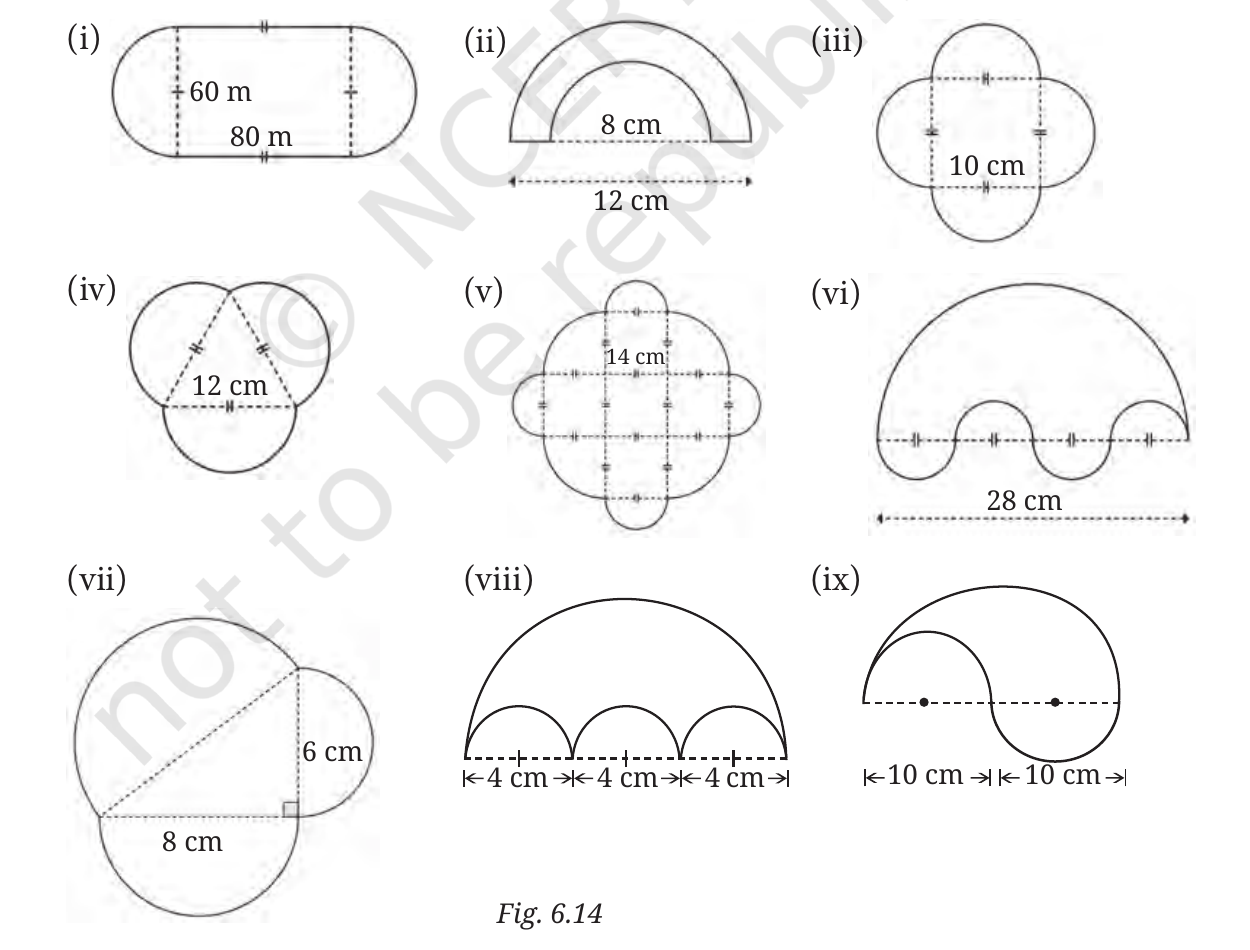
Find the perimeters of the following shapes (taking the arcs to be quarter or half or three-quarters of a circle, as appropriate) (Fig. 6.14i to 6.14ix):
AIMS worked solution
Given
Find the nine perimeters in Fig. 6.14, using the stated quarter/half-circle arcs and π≈.
To Find
Perimeters in source figure order (i)–(ix)
Reasoning
Add boundary arcs and exposed straight edges only. Dashed construction lines are not boundary.
Solution
(i) Two straight lengths 80 m and two semicircles of diameter 60 m: P = 160+60π≈ m.
The source repeats equality ticks on sides labelled 60 and 80
the numerical dimensions, not those inconsistent ticks, are used here.
(ii) Semicircular band with outer diameter 12 cm and inner diameter 8 cm: P = 6π+4π+(12−8) = 10π+4≈ cm.
(iii) Four outward semicircles on a side-10 cm square: P = 4 × 5π = 20π≈ cm.
(iv) Three semicircles of diameter 12 cm: P = 18π≈ cm.
(v) Write s for each equal marked grid interval.
Four radius-s quarter circles and four diameter-s semicircles give P = 2πs+2πs = 4πs.
Reading the 14 cm label as one marked interval gives P = 56π≈176 cm.
This dimension convention must be stated because the source has no dimension-arrow endpoints for the label.
(vi) One diameter-28 cm semicircle plus four diameter-7 cm semicircles: P = 14π+4 × 3.5π = 28π≈88 cm.
(vii) The perpendicular sides 6,8 give hypotenuse 10.
Three semicircles have these diameters: P = (6+8+10) = 12π≈ cm.
(viii) Diameter-12 cm outer semicircle plus three diameter-4 cm semicircles: P = 6π+3 × 2π = 12π≈ cm.
(ix) Diameter-20 cm outer semicircle plus two diameter-10 cm semicircles: P = 10π+5π+5π = 20π≈ cm.
Result
In order: m; ,,,176,88,,, cm, with the stated source conventions.
Compare the reasoning with your own work. Reading a solution does not record mastery.
Exercise Set 6.1 — Question 6
Printed page 130
Unless stated otherwise, use the approximation for π.
If the diameter of a car tyre is 56 cm, then:
(i) How far does the car need to travel for the tyre to complete one revolution?
(ii) How many revolutions does the tyre make if the car travels 10 km?
AIMS worked solution
Given
A car tyre has diameter 56 cm. Find travel in one revolution and revolutions in 10 km. Use π≈ and rolling without slipping.
To Find
Rolling distance and rotation count
Reasoning
Distance = number of turns × circumference.
Solution
One revolution = πd = () × 56 = 176 cm = 1.76 m.
10 km = 1000000 cm.
Turns = = ≈5681.818.
This is 5681 complete revolutions plus of another
do not round it to an exact integer count.
Result
176 cm per turn; turns over 10 km.
Compare the reasoning with your own work. Reading a solution does not record mastery.
Exercise Set 6.1 — Question 7
Printed page 130
Unless stated otherwise, use the approximation for π.
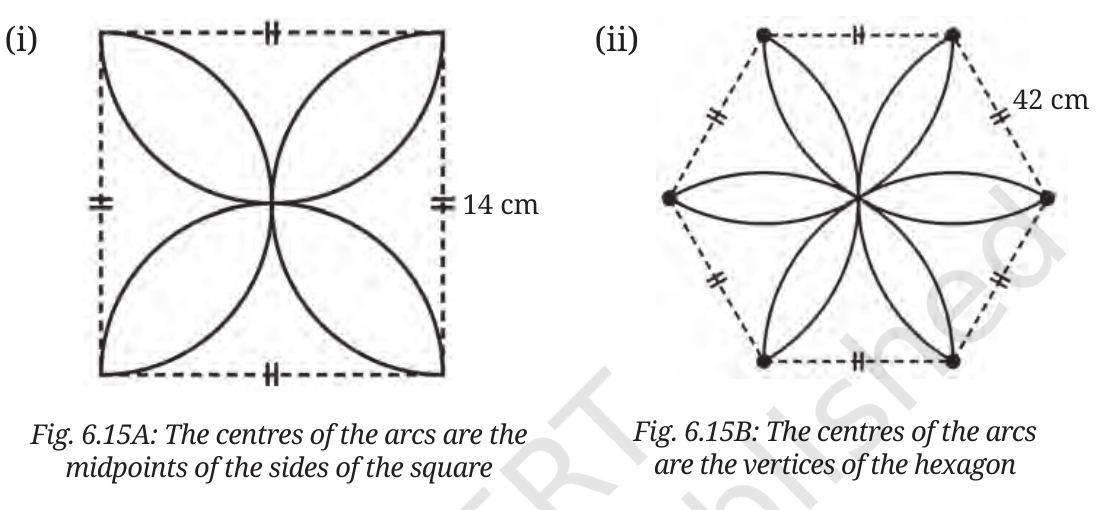
Find the total perimeter of all the petals in each of the given flowers.
Fig. 6.15A: The centres of the arcs are the midpoints of the sides of the square.
Fig. 6.15B: The centres of the arcs are the vertices of the hexagon.
AIMS worked solution
Given
Find total petal perimeters in Fig. 6.15: (i) square side 14 cm, arc centres at side midpoints; (ii) the depicted regular hexagon of side 42 cm, arc centres at vertices.
To Find
Total curved boundary lengths
Reasoning
Sum the arcs around all petals; use π≈.
Solution
(i) Each of four petals has two quarter-circle arcs of radius 7.
Total = 8 × () × 2π × 7 = 28π≈88 cm.
(ii) Under the depicted regular-hexagon construction, each of six petals has two 60° arcs of radius 42.
Total = 12 × () × 2π × 42 = 168π≈528 cm.
Equal side marks alone do not prove an arbitrary hexagon regular.
The second result uses the regular arrangement shown
without its angle/symmetry condition, side length alone does not fix the arc angles.
Result
(i) 88 cm. (ii) 528 cm for the stated regular-hexagon arrangement.
Compare the reasoning with your own work. Reading a solution does not record mastery.
Exercise Set 6.1 — Question 8
Printed page 130
Unless stated otherwise, use the approximation for π.
The ratio of the perimeters of two circles is 5:4. What is the ratio of their radii?
AIMS worked solution
Given
Two circle perimeters are in the ratio 5:4.
To Find
Ratio of their radii
Reasoning
C = 2πr, with the same constant factor for both circles.
Solution
C1/C2 = = r1/r2.
Result
5:4.
Compare the reasoning with your own work. Reading a solution does not record mastery.
Exercise Set 6.2 — Question 1
Printed page 142
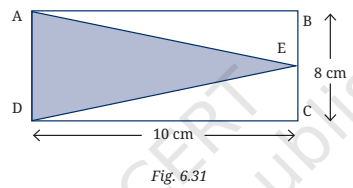
Find the area of triangle ADE in Fig. 6.31.
AIMS worked solution
Given
In rectangle ABCD of width 10 cm and height 8 cm, E lies on BC (Fig. 6.31). Find area of △ADE.
To Find
Area of △ADE
Reasoning
Triangle area = half base × perpendicular height.
Solution
Take AD = 8 cm as base.
The perpendicular distance from E to AD is the rectangle width 10 cm.
Area = 8 × = 40 , regardless of E’s position on BC.
Result
40 .
Compare the reasoning with your own work. Reading a solution does not record mastery.
Exercise Set 6.2 — Question 2
Printed page 142
The parallel sides of a trapezium are 40 cm and 20 cm. If its non-parallel sides are both equal, each being 26 cm, find the area of the trapezium.
AIMS worked solution
Given
An isosceles trapezium has parallel sides 40 cm and 20 cm and legs 26 cm.
To Find
Trapezium area
Reasoning
A perpendicular from each end of the shorter base leaves equal overhangs.
Solution
Each overhang = = 10 cm.
Height h satisfies = − = 576, so h = 24 cm.
Area = (40+20) × = 720 .
Result
720 .
Compare the reasoning with your own work. Reading a solution does not record mastery.
Exercise Set 6.2 — Question 3
Printed page 142
Find the area of a triangle, given that its sides are 8 cm and 11 cm long, and its perimeter is 32 cm.
AIMS worked solution
Given
A triangle has sides 8 cm and 11 cm and perimeter 32 cm.
To Find
Triangle area
Reasoning
Heron’s formula A = .
Solution
Third side = 32−8−11 = 13 cm
semiperimeter s = 16 cm.
Area = = = 8 .
Result
8 .
Compare the reasoning with your own work. Reading a solution does not record mastery.
Exercise Set 6.2 — Question 4
Printed page 142
The sides of a triangular plot are in the ratio 3: 5: 7; its perimeter is 300 m. Find its area.
AIMS worked solution
Given
A triangular plot has side ratio 3:5:7 and perimeter 300 m.
To Find
Plot area
Reasoning
Scale the ratio, then apply Heron’s formula.
Solution
One ratio unit = = 20 m
sides are 60,100,140 m.
s = 150 m.
A = = = 1500 .
Result
1500 .
Compare the reasoning with your own work. Reading a solution does not record mastery.
Exercise Set 6.2 — Question 5
Printed page 142
One diagonal of a rhombus is twice as long as the other diagonal. If the rhombus has area 128 , find the length of the shorter diagonal.
AIMS worked solution
Given
A rhombus has area 128 and one diagonal is twice the other.
To Find
Shorter diagonal length
Reasoning
Rhombus area = half the product of its diagonals.
Solution
Let the shorter diagonal be d > 0 and the longer be 2d.
128 = d × 2 = , giving d = = 8 cm.
Result
8 cm.
Compare the reasoning with your own work. Reading a solution does not record mastery.
Exercise Set 6.2 — Question 6
Printed page 142
ABCD is a parallelogram. P and Q are any two points on side AB. What can you say about the ratio area (ΔPCD): area (ΔQCD)?
AIMS worked solution
Given
P and Q lie on AB of parallelogram ABCD. Compare areas △PCD and △QCD.
To Find
Ratio of the two triangle areas
Reasoning
Common base CD and equal perpendicular heights between parallel lines AB and CD.
Solution
Both triangle areas equal CD × .
Result
1:1.
Compare the reasoning with your own work. Reading a solution does not record mastery.
Exercise Set 6.2 — Question 7
Printed page 142
O is any point on the diagonal PR of a parallelogram PQRS. Prove that the areas of triangles PSO and PQO are equal.
AIMS worked solution
Given
O lies on diagonal PR of parallelogram PQRS. Prove equal areas for △PSO and △PQO.
To Prove
Equality of the two areas
Reasoning
A parallelogram diagonal divides its area in half; triangles on the same line have area proportional to base.
Proof
△PSR and △PQR each have half the parallelogram area.
Their subtriangles PSO and PQO have common base PO on line PR.
Each is the fraction of its respective larger triangle.
Multiplying equal areas by the same fraction gives equal areas.
If O = P, both areas are zero.
Result
Area(△PSO) = Area(△PQO).
Compare the reasoning with your own work. Reading a solution does not record mastery.
Exercise Set 6.2 — Question 8
Printed page 142
If the mid-points of the sides of a 4-gon (also known as a quadrilateral, but we prefer to call it a ‘4-gon’) are joined in order, prove that the area of the parallelogram thus formed will be half of the area of the given 4-gon. (You may wonder whether the 4-gon thus formed is always a parallelogram, and if so, why? These questions will be tackled and answered in the chapter on quadrilaterals.)
AIMS worked solution
Given
Join consecutive side midpoints of a quadrilateral. Prove the resulting parallelogram has half the original area.
To Prove
Midpoint-parallelogram area relationship
Reasoning
Midpoint theorem and area decomposition for a simple quadrilateral.
Proof
For convex ABCD let E,F,G,H be consecutive side midpoints.
In triangles ABC and ADC, EF and HG are each parallel to AC and half its length.
Similarly FG and HE are parallel and equal, giving a parallelogram.
Each corner triangle is one-quarter of the triangle made by that corner and its two neighbouring vertices.
The sum of those four larger triangle areas is twice area(ABCD).
The removed corner triangles therefore total half the original area.
The inner parallelogram occupies the remaining half.
For a simple concave quadrilateral the same identity follows with signed areas: substituting E = , F = , G = , H = in the polygon area sum gives exactly half the original signed sum.
Take absolute values.
Self-crossing figures require a different convention for area.
Result
The midpoint parallelogram has half the area of the simple quadrilateral.
Compare the reasoning with your own work. Reading a solution does not record mastery.
Exercise Set 6.2 — Question 9
Printed page 143
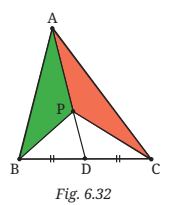
In ∆ABC, the midpoint of BC is D (Fig. 6.32). Median AD is drawn. P is any point on AD. Show that area (∆ABP) = area (∆ACP).
AIMS worked solution
Given
D is the midpoint of BC in △ABC; P lies on median AD. Prove area(△ABP) = area(△ACP).
To Prove
Equality of the areas on opposite sides of AP
Reasoning
Equal bases on line BC give equal areas for triangles with common apex.
Proof
BD = DC, so area(ABD) = area(ACD) and area(PBD) = area(PCD).
Subtract the second equality from the first.
The remainders are ABP and ACP.
Endpoint cases follow as well.
Result
Area(△ABP) = area(△ACP).
Compare the reasoning with your own work. Reading a solution does not record mastery.
Exercise Set 6.2 — Question 10
Printed page 143
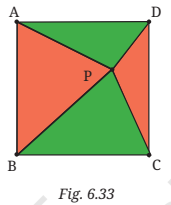
Given a square ABCD, let P be a point within it. Join PA, PB, PC, PD (Fig. 6.33). What is the ratio of the areas of the red region (∆PAB and ∆PCD) and the green region (∆PBC and ∆PDA)?
AIMS worked solution
Given
P lies inside square ABCD. Compare the combined areas PAB+PCD with PBC+PDA.
To Find
Ratio of the two opposite-pair area sums
Reasoning
Distances from an interior point to opposite sides add to the square side.
Solution
Let side length be s.
If distances from P to AB and CD are h and s−h, their triangle areas sum to s = .
The other opposite pair also sums to .
Result
1:1.
Compare the reasoning with your own work. Reading a solution does not record mastery.
Exercise Set 6.2 — Question 11
Printed page 143
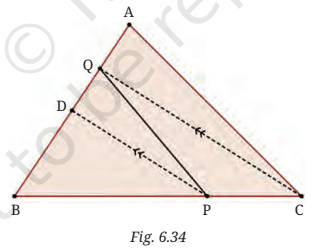
In ∆ABC, D is the midpoint of AB. P is any point on BC, and Q is a point on AB such that CQ ∥ PD. PQ is joined (Fig. 6.34). Prove that Area (∆BPQ) = Area (∆ABC).
AIMS worked solution
Given
D is the midpoint of AB in △ABC. P lies on BC; draw CQ parallel to PD to meet line AB at Q. Prove area(BPQ) = area, and check the source’s requirement that Q lie on side AB.
To Prove
Area identity and valid placement of Q
Reasoning
Similar triangles BPD and BCQ give proportional sides.
Proof
For P≠B, = .
Since BD = , ()() = .
Triangles BPQ and BAC have the same included angle at B, so their area ratio is that product, .
To keep Q on segment AB, BQ ≤ BA requires BP ≥ .
If P is nearer B than the midpoint of BC, Q lies on AB extended beyond A.
At P = B the construction is undefined.
Thus the source’s “any point” and “Q on AB” need this qualification
the area identity remains valid for the permitted construction, including Q on the extension.
Result
Area(BPQ) = area for P≠B; Q lies on side AB only when BP ≥ .
Compare the reasoning with your own work. Reading a solution does not record mastery.
Exercise Set 6.3 — Question 1
Printed page 148
Unless stated otherwise, use the approximation for π.
Find the area of a sector of a circle with radius 7 cm if the angle of the sector is 60°.
AIMS worked solution
Given
Find area of a sector with radius 7 cm and angle 60°, using π≈.
To Find
Sector area
Reasoning
A = (θ/360)π.
Solution
A = () × × 49 = .
Result
.
Compare the reasoning with your own work. Reading a solution does not record mastery.
Exercise Set 6.3 — Question 2
Printed page 148
Unless stated otherwise, use the approximation for π.
Find the area of a quadrant of a circle whose circumference is 44 cm.
AIMS worked solution
Given
Find area of a quadrant of a circle with circumference 44 cm, using π≈.
To Find
Quadrant area
Reasoning
r = ; a quadrant is one-quarter of the circle.
Solution
r = 7 cm.
Area = π × = 38.5 using .
Result
38.5 .
Compare the reasoning with your own work. Reading a solution does not record mastery.
Exercise Set 6.3 — Question 3
Printed page 148
Unless stated otherwise, use the approximation for π.
The length of the minute hand of a clock is 7 cm. Find the area swept by the minute hand in 10 minutes.
AIMS worked solution
Given
A clock minute hand is 7 cm long. Find the area it sweeps in 10 minutes, using π≈.
To Find
Swept sector area
Reasoning
The hand completes 360° in 60 minutes.
Solution
Angle = 360 × = 60°.
Area = () × × 49 = .
Result
.
Compare the reasoning with your own work. Reading a solution does not record mastery.
Exercise Set 6.3 — Question 4
Printed page 148
Unless stated otherwise, use the approximation for π.
A chord of a circle of radius 10 cm subtends 90° at the centre. Find the area of the corresponding:
(i) minor sector (that subtends 90° at the centre), and
(ii) major sector (that subtends 270° at the centre). (Use π ≈ 3.14.)
AIMS worked solution
Given
A radius-10 cm circle has a chord subtending 90°. Find minor and major sector areas using π≈3.14.
To Find
The two sector areas
Reasoning
Sectors occupy and of the whole circle.
Solution
Whole area = 3.14 × 100 = 314 .
Minor sector = 78.5
major sector = 235.5 .
Result
78.5 and 235.5 .
Compare the reasoning with your own work. Reading a solution does not record mastery.
Exercise Set 6.3 — Question 5
Printed page 148
Unless stated otherwise, use the approximation for π.
A chord of a circle of radius 15 cm subtends an angle of 60° at the centre of the circle. Find the areas of the corresponding minor and major segments of the circle. (Use π ≈ 3.14 and ≈ 1.73.)
AIMS worked solution
Given
In a radius-15 cm circle, a chord subtends 60°. Find minor and major segment areas using π≈3.14 and ≈1.73.
To Find
Minor and major circular-segment areas
Reasoning
Subtract the equilateral triangle from the 60° sector.
Solution
Sector area = () × 3.14 × 225 = 117.75 .
Triangle area = () × 225≈97.3125 .
Minor segment ≈117.75−97.3125 = 20.4375 .
Whole circle ≈706.5 , so major segment ≈706.5−20.4375 = 686.0625 .
Result
Approximately 20.4375 and 686.0625 with the prescribed approximations.
Compare the reasoning with your own work. Reading a solution does not record mastery.
Exercise Set 6.3 — Question 6
Printed page 148
Unless stated otherwise, use the approximation for π.
A car has two wipers which do not overlap. Each wiper has a blade of length 28 cm and sweeps through an angle of 120°. Find the total area cleaned at each sweep of the blades.
AIMS worked solution
Given
Two non-overlapping wipers each sweep 120° with a 28 cm blade. Find the total area cleaned using π≈.
To Find
Combined swept area
Reasoning
Use the source model of two radius-28 cm sectors with blades extending from their pivots.
Solution
One sector = () × × = .
Two disjoint sweeps give .
If a blade starts away from the pivot, an inner radius is needed instead
this answer uses the source sector model.
Result
in the stated model.
Compare the reasoning with your own work. Reading a solution does not record mastery.
End-of-chapter Exercises — Question 1
Printed page 149
Unless stated otherwise, use the approximation for π.
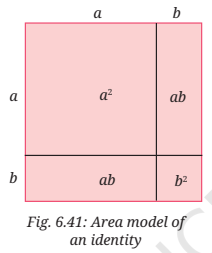
Identities in algebra can sometimes be shown as area relationships. For example:
The figure shown corresponds to the identity (a + b) = + 2ab + .
Do you see how?
Draw figures corresponding to the identities (a + b)(a − b) = − and (a + b + c) = + + + 2ab + 2bc + 2ca.
AIMS worked solution
Given
Explain the area identity (a+b) and draw area models for (a+b)(a−b) = − and (a+b+c) = +++2ab+2bc+2ca.
To Find
Geometric decompositions for the identities
Reasoning
Areas add when a region is partitioned without gaps or overlap.
Solution
The side-(a+b) square splits at lengths a and b in both directions into , and two ab rectangles.
For a ≥ b > 0, remove a side-b square from a side-a square at a corner.
Split the L-shaped remainder into rectangles a × (a−b) and b × (a−b)
place them together to form (a+b) × (a−b).
For the third identity, split each side of the (a+b+c) square into lengths a,b,c.
The nine cells have areas ,,,ab,ab,bc,bc,ca,ca.
The geometric constructions use non-negative lengths
the algebraic identities themselves extend beyond that restriction.
Result
The decomposed areas give exactly the three stated expansions.
Compare the reasoning with your own work. Reading a solution does not record mastery.
End-of-chapter Exercises — Question 2
Printed page 149
Unless stated otherwise, use the approximation for π.
An isosceles triangle has perimeter 40 cm; the equal sides are 15 cm each. Find the area of the triangle.
AIMS worked solution
Given
An isosceles triangle has perimeter 40 cm and equal sides 15 cm.
To Find
Triangle area
Reasoning
Its altitude bisects the base.
Solution
Base = 40−30 = 10 cm.
Half-base = 5 cm.
Height = = = 10 cm.
Area = 10 × = 50 .
Result
50 .
Compare the reasoning with your own work. Reading a solution does not record mastery.
End-of-chapter Exercises — Question 3
Printed page 149
Unless stated otherwise, use the approximation for π.
An isosceles triangle has base 10 cm, and its area is 60 . What are the lengths of the equal sides?
AIMS worked solution
Given
An isosceles triangle has base 10 cm and area 60 .
To Find
Length of each equal side
Reasoning
Find the height from area, then apply the right-triangle theorem.
Solution
60 = 10 gives h = 12 cm.
Half-base = 5 cm.
Equal side = = 13 cm.
Result
13 cm each.
Compare the reasoning with your own work. Reading a solution does not record mastery.
End-of-chapter Exercises — Question 4
Printed page 149
Unless stated otherwise, use the approximation for π.
The area of a right-angled triangle is 54 sq. cm. One of its legs has length 12 cm. Find its perimeter.
AIMS worked solution
Given
A right triangle has area 54 and one leg 12 cm.
To Find
Triangle perimeter
Reasoning
A = , then = +.
Solution
Other leg = = 9 cm.
Hypotenuse = = 15 cm.
Perimeter = 12+9+15 = 36 cm.
Result
36 cm.
Compare the reasoning with your own work. Reading a solution does not record mastery.
End-of-chapter Exercises — Question 5
Printed page 149
Unless stated otherwise, use the approximation for π.
The sides of a triangle are in the ratio 2: 3: 4, and its perimeter is 45 cm. Find its area.
AIMS worked solution
Given
Triangle sides are in ratio 2:3:4 and perimeter is 45 cm.
To Find
Triangle area
Reasoning
Heron’s formula.
Solution
Sides are 10,15,20 cm
semiperimeter is cm.
Area = = = .
Result
.
Compare the reasoning with your own work. Reading a solution does not record mastery.
End-of-chapter Exercises — Question 6
Printed page 149
Unless stated otherwise, use the approximation for π.
The sides of a triangle have lengths 7 cm, 24 cm, 25 cm. Find the area of the triangle in two different ways.
AIMS worked solution
Given
Find the area of a triangle with sides 7,24,25 cm in two ways.
To Find
Area by right-triangle and Heron methods
Reasoning
+ = 49+576 = 625 = , so the converse establishes a right angle. Method 1: A = 7 × = 84 . Method 2: s = 28; A = = = 84 .
Solution
The two independent methods agree.
Result
84 .
Compare the reasoning with your own work. Reading a solution does not record mastery.
End-of-chapter Exercises — Question 7
Printed page 149
Unless stated otherwise, use the approximation for π.
If the wheel of a bicycle has a diameter of 60 cm, find how far a cyclist will have travelled after the wheel has rotated 100 times.
AIMS worked solution
Given
A bicycle wheel has diameter 60 cm and makes 100 turns without slipping. Use π≈.
To Find
Travel distance
Reasoning
Distance = turns × πd.
Solution
100 × π × 60 cm = 6000π cm = 60π m≈ m.
Result
m ≈188.57 m.
Compare the reasoning with your own work. Reading a solution does not record mastery.
End-of-chapter Exercises — Question 8
Printed page 150
Unless stated otherwise, use the approximation for π.
Find the area of a quadrant of a circle whose circumference is 66 cm.
AIMS worked solution
Given
Find the quadrant area when the circle circumference is 66 cm. Use π≈.
To Find
Quadrant area
Reasoning
r = ; quadrant area = .
Solution
r = 66 × = 10.5 cm.
A = () × = 86.625 .
Result
86.625 .
Compare the reasoning with your own work. Reading a solution does not record mastery.
End-of-chapter Exercises — Question 9
Printed page 150
Unless stated otherwise, use the approximation for π.
The wheel of a car has an outer radius of 28 cm. Calculate how far the car travels after one complete turn of the wheel, and how many times the wheel turns during a journey of 1 km.
AIMS worked solution
Given
A car wheel has outer radius 28 cm. Find distance per turn and turns in 1 km, using π≈ and no slipping.
To Find
Rolling distance and turns
Reasoning
C = 2πr; turns = distanc.
Solution
C = 2 × × 28 = 176 cm = 1.76 m.
1 km = 100000 cm
turns = = ≈568.182.
Result
176 cm per turn; turns in 1 km.
Compare the reasoning with your own work. Reading a solution does not record mastery.
End-of-chapter Exercises — Question 11
Printed page 150
Unless stated otherwise, use the approximation for π.
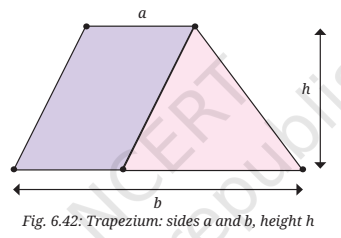
You know that the area of a parallelogram is base × height. Using this and the figure, show that the area of a trapezium is half the sum of the parallel sides × height, i.e., (a + b)h.
Fig. 6.42: Trapezium: sides a and b, height h.
AIMS worked solution
Given
Use the parallelogram in Fig. 6.42 to derive the trapezium area formula for parallel sides a,b and height h.
To Find
Area of the trapezium
Reasoning
Complete the trapezium to a parallelogram and remove the excess triangle.
Solution
Extend the shorter top base to length b, forming a parallelogram with the same base b and height h.
The added triangle has base b−a and height h.
Trapezium area = bh−(b−a) = (a+b).
Result
A = (a+b).
Compare the reasoning with your own work. Reading a solution does not record mastery.
End-of-chapter Exercises — Question 12
Printed page 150
Unless stated otherwise, use the approximation for π.
By dividing a trapezium into two triangles show that its area is, half the sum of the parallel sides multiplied by the height (the same formula as the one given above).
AIMS worked solution
Given
Divide a trapezium into two triangles to derive its area formula.
To Find
Area from a diagonal partition
Reasoning
The two triangles have bases a and b and the common perpendicular height h between parallel sides.
Solution
Draw either diagonal.
Triangle areas are and .
Add them: A = (a+b).
Result
A = (a+b).
Compare the reasoning with your own work. Reading a solution does not record mastery.
End-of-chapter Exercises — Question 13
Printed page 150
Unless stated otherwise, use the approximation for π.
Show how we can use two identical copies of a trapezium to make a parallelogram. How will this give us the formula for the area of a trapezium?
AIMS worked solution
Given
Fit two identical trapezia together to form a parallelogram and derive the area formula.
To Find
Area of one trapezium
Reasoning
A half-turn of a copy permits a shared non-parallel edge.
Solution
Join a trapezium to its rotated copy along a non-parallel side.
The resulting parallelogram has base a+b and height h.
Its area is (a+b)h, twice one trapezium’s area.
Result
A = (a+b).
Compare the reasoning with your own work. Reading a solution does not record mastery.
End-of-chapter Exercises — Question 14
Printed page 150
Unless stated otherwise, use the approximation for π.
Show that the area of a kite is half the product of its diagonals. Show this:
(i) using algebra, and
(ii) using geometry.
AIMS worked solution
Given
Show algebraically and geometrically that a kite has half the product of its diagonals as its area.
To Find
Kite area formula
Reasoning
The symmetry diagonal bisects the other at right angles.
Solution
Let perpendicular diagonals be d1 and d2, with the first divided into lengths x,y, so x+y = d1.
Algebra: the two triangles with base d2 have heights x,y.
Their total area = d2 = d1d.
Geometry: split along both diagonals into four right triangles.
Duplicate the kite
pair each matching triangle across its hypotenuse into a rectangle.
The four rectangles have total area d1d2, so one kite has half that area.
This argument uses a convex kite and its perpendicular, internally intersecting diagonals.
Result
A = d1d.
Compare the reasoning with your own work. Reading a solution does not record mastery.
End-of-chapter Exercises — Question 15
Printed page 150
Unless stated otherwise, use the approximation for π.
Three problems about fitting congruent shapes together:
(i) Rectangle ABCD has sides a, b, and rectangle PQRS has sides 2a, 2b. Show that PQRS has 4 times the area of ABCD. Does this mean that 4 copies of rectangle ABCD will fit into rectangle PQRS? Check and see!
(ii) ∆ABC has sides a, b, c, and ∆PQR has sides 2a, 2b, 2c. Show that ∆PQR has 4 times the area of ∆ABC. Does this mean that 4 copies of ∆ABC will fit into ∆PQR? Check and see!
(iii) ∆ABC has sides a, b, c, and ∆PQR has sides 3a, 3b, 3c. Show that ∆PQR has 9 times the area of ∆ABC. Does this mean that 9 copies of ∆ABC will fit into ∆PQR? Check and see!
AIMS worked solution
Given
Show the area scale and whether congruent copies fit: (i) rectangle sides a,b enlarged to 2a,2b; (ii) triangle sides a,b,c doubled; (iii) the triangle sides tripled (continued page 151).
To Find
Area ratios and actual dissections
Reasoning
Uniform scaling multiplies area by the square of the length factor; a tiling needs a construction as well.
Solution
(i) Area (2a)(2b) = 4ab.
Bisect both sides to make a 2 × 2 grid of four original rectangles.
(ii) The doubled triangle has area four times the original by similarity.
Join its three side midpoints: four triangles have side lengths a,b,c, so SSS makes all four congruent to the original.
(iii) The tripled triangle has nine times the area.
Trisect each side and draw lines parallel to the other sides through the trisection points.
The triangular grid contains nine small triangles (six one way, three inverted), each with sides a,b,c.
Thus the equal area totals are accompanied by explicit gap-free tilings, rather than used alone to infer a fit.
Result
Four rectangle copies; four triangle copies; nine triangle copies.
Compare the reasoning with your own work. Reading a solution does not record mastery.
End-of-chapter Exercises — Question 17
Printed page 151
Unless stated otherwise, use the approximation for π.
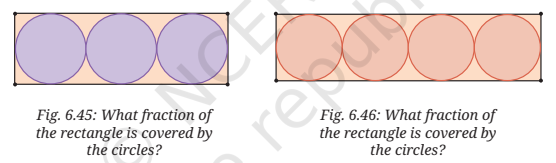
Fig. 6.45: What fraction of the rectangle is covered by the circles?
Fig. 6.46: What fraction of the rectangle is covered by the circles?
AIMS worked solution
Given
Find the covered-area fraction for the rows of three and four congruent tangent circles fitted exactly in their rectangles (Figs. 6.45–6.46).
To Find
Circle-covered fraction in each rectangle
Reasoning
For n radius-r circles in one row, the tight rectangle is 2nr by 2r.
Solution
Three circles: area 3π
rectangle area (6r)(2r) = .
Ratio = .
Four circles: area 4π
rectangle area (8r)(2r) = .
Ratio = .
Result
Both fractions are , approximated by with π≈.
Compare the reasoning with your own work. Reading a solution does not record mastery.
End-of-chapter Exercises — Question 18
Printed page 151
Unless stated otherwise, use the approximation for π.
Use the above to make a conjecture about the area occupied by circles fitted into a rectangle in the manner shown. Test your conjecture for particular cases: 10 circles; 20 circles; 50 circles. Then prove your conjecture!
AIMS worked solution
Given
Conjecture and prove the fraction covered by equal circles in a tight rectangular row. Test 10,20 and 50 circles.
To Prove
General fraction and three test cases
Reasoning
Area ratios cancel the common number of circles and squared radius.
Proof
For 10 circles: circle area 10π, rectangle area
ratio .
For 20: 20π/ = .
For 50: 50π/ = .
Generally, n tangent equal circles in a tight single row have area nπ and rectangle area (2nr)(2r) = .
Their ratio is for n ≥ 1,r > 0.
The same calculation holds for a tight rectangular grid of equal circles.
It is not a claim about arbitrary packings, margins or unequal radii.
Result
The covered fraction is always for the specified arrangement.
Compare the reasoning with your own work. Reading a solution does not record mastery.