
Propositions and their Converses
Textbook Exercises & Solutions
Think first. Use AI purposefully. Verify always.
Choose Try It Yourself to develop your reasoning, or View Solution to read the complete solution straight away.
Starred textbook questions are collected separately in ★ AIMS Think+.
Exercise 9.1 — Question 1
Printed page 5
Frame the converse for each of the propositions in Questions 1–12. Then, determine if each of the two statements is true or not. Justify the true statements and give a counterexample for each false statement.
If two lines are parallel, then the corresponding angles formed by a transversal are equal.
AIMS worked solution
Given
Two lines are cut by a transversal. Investigate the statement that parallel lines give equal corresponding angles, and its converse.
To Find
Truth of the proposition and its converse
Reasoning
Corresponding-angle theorem and its converse.
Solution
Forward: parallel lines cut by a transversal have equal corresponding angles.
Converse: if a pair of corresponding angles is equal, the two lines are parallel.
Result
Both directions are true.
Compare the reasoning with your own work. Reading a solution does not record mastery.
Exercise 9.1 — Question 2
Printed page 5
Frame the converse for each of the propositions in Questions 1–12. Then, determine if each of the two statements is true or not. Justify the true statements and give a counterexample for each false statement.
If a quadrilateral is a square, then all its angles are equal.
AIMS worked solution
Given
Investigate: a square has all its angles equal. Form and test the converse.
To Find
Truth of both quadrilateral statements
Reasoning
A quadrilateral has angle sum 360°; a square has four right angles.
Solution
Forward: every square has four angles of 90°, so its angles are equal.
Converse: an equal-angle quadrilateral need not be a square.
A 2 cm by 3 cm rectangle has four right angles but unequal adjacent sides.
Result
Forward true; converse false.
Compare the reasoning with your own work. Reading a solution does not record mastery.
Exercise 9.1 — Question 4
Printed page 6
Frame the converse for each of the propositions in Questions 1–12. Then, determine if each of the two statements is true or not. Justify the true statements and give a counterexample for each false statement.
If x = y, then a + x = a + y, where x, y and a are any three numbers.
This proposition and its converse are routinely used while solving equations.
AIMS worked solution
Given
For numbers x, y and a, investigate x = y ⇒ a + x = a + y and its converse.
To Find
Truth of both equality statements
Reasoning
Adding or subtracting the same quantity preserves equality.
Solution
Forward: add a to both sides of x = y.
Converse: subtract a from both sides of a + x = a + y to obtain x = y.
Result
Both directions are true.
Compare the reasoning with your own work. Reading a solution does not record mastery.
Exercise 9.1 — Question 5
Printed page 6
Frame the converse for each of the propositions in Questions 1–12. Then, determine if each of the two statements is true or not. Justify the true statements and give a counterexample for each false statement.
If a and b are perfect squares, then ab is a perfect square.
AIMS worked solution
Given
Investigate: if a and b are perfect squares, then ab is a perfect square. Form the converse.
To Find
Truth of the square-product claim and its converse
Reasoning
Represent squares as products of equal integers.
Solution
Forward: write a = and b = .
Then ab = (mn), a perfect square.
Converse: if ab is a square, a and b need not both be squares.
For example, 3 × 12 = 36, but neither 3 nor 12 is a perfect square.
Result
Forward true; converse false.
Compare the reasoning with your own work. Reading a solution does not record mastery.
Exercise 9.1 — Question 6
Printed page 6
Frame the converse for each of the propositions in Questions 1–12. Then, determine if each of the two statements is true or not. Justify the true statements and give a counterexample for each false statement.
In Questions 6 and 7, x and y are real numbers.
If x = y, then = .
AIMS worked solution
Given
For real x and y, investigate x = y ⇒ = and its converse.
To Find
Truth of the two real-square statements
Reasoning
Equal inputs have equal squares; opposite real numbers also have equal squares.
Solution
Forward: squaring the same real number gives the same result.
Converse: = (−2) = 4, but 2 ≠ −2.
Equivalently, (x−y)(x+y) = 0 allows x = y or x = −y.
Result
Forward true; converse false.
Compare the reasoning with your own work. Reading a solution does not record mastery.
Exercise 9.1 — Question 7
Printed page 6
Frame the converse for each of the propositions in Questions 1–12. Then, determine if each of the two statements is true or not. Justify the true statements and give a counterexample for each false statement.
In Questions 6 and 7, x and y are real numbers.
If x = y, then = .
AIMS worked solution
Given
For real x and y, investigate x = y ⇒ = and its converse.
To Find
Truth of the two real-cube statements
Reasoning
The cube function is strictly increasing on the real numbers.
Solution
Forward: equal inputs have equal cubes.
Converse: − = (x−y)(+xy+).
The second factor equals (x+)+3 and is positive unless x = y = 0.
If the cubes are equal, either that zero case holds or x−y = 0.
In either case x = y.
Result
Both directions are true.
Compare the reasoning with your own work. Reading a solution does not record mastery.
Exercise 9.1 — Question 8
Printed page 6
Frame the converse for each of the propositions in Questions 1–12. Then, determine if each of the two statements is true or not. Justify the true statements and give a counterexample for each false statement.
In Questions 8–12, n is a positive integer.
If n is divisible by 24, then it is divisible by both 4 and 6.
AIMS worked solution
Given
For a positive integer n, investigate divisibility by 24 ⇒ divisibility by both 4 and 6.
To Find
Truth of the divisibility claim and its converse
Reasoning
A multiple of 24 is a multiple of each divisor of 24.
Solution
Forward: n = 24k gives n = 4(6k) = 6(4k).
Converse: 12 is divisible by 4 and 6, but not by 24.
Result
Forward true; converse false.
Compare the reasoning with your own work. Reading a solution does not record mastery.
Exercise 9.1 — Question 9
Printed page 6
Frame the converse for each of the propositions in Questions 1–12. Then, determine if each of the two statements is true or not. Justify the true statements and give a counterexample for each false statement.
In Questions 8–12, n is a positive integer.
If n is divisible by 60, then it is divisible by both 5 and 12.
AIMS worked solution
Given
For a positive integer n, investigate divisibility by 60 ⇒ divisibility by both 5 and 12.
To Find
Truth of the divisibility claim and its converse
Reasoning
5 and 12 are coprime; their least common multiple is 60.
Solution
Forward: n = 60k is divisible by both 5 and 12.
Converse: divisibility by 12 supplies factors and 3.
Divisibility by 5 supplies the separate prime factor 5.
Hence × 3 × 5 = 60 divides n.
Result
Both directions are true.
Compare the reasoning with your own work. Reading a solution does not record mastery.
Exercise 9.1 — Question 10
Printed page 6
Frame the converse for each of the propositions in Questions 1–12. Then, determine if each of the two statements is true or not. Justify the true statements and give a counterexample for each false statement.
In Questions 8–12, n is a positive integer.
If n is the square of a prime number, then it has exactly 3 factors.
AIMS worked solution
Given
For positive integer n, investigate: n is the square of a prime ⇒ n has exactly three positive factors.
To Find
Truth of the factor-count statement and its converse
Reasoning
Positive factors pair about .
Solution
Forward: if n = with p prime, its factors are exactly 1,p,.
Converse: if n has exactly three positive factors, write them as 1,d,n.
The middle factor must pair with itself, so = n.
If d were composite, it would have a factor strictly between 1 and d, producing a fourth factor of n.
Thus d is prime.
Result
Both directions are true.
Compare the reasoning with your own work. Reading a solution does not record mastery.
Exercise 9.1 — Question 11
Printed page 6
Frame the converse for each of the propositions in Questions 1–12. Then, determine if each of the two statements is true or not. Justify the true statements and give a counterexample for each false statement.
In Questions 8–12, n is a positive integer.
If n is a product of two unequal prime numbers, then it has exactly 4 divisors.
AIMS worked solution
Given
For positive integer n, investigate: n is the product of two unequal primes ⇒ n has exactly four positive divisors.
To Find
Truth of the divisor-count claim and its converse
Reasoning
A product of distinct primes p,q has divisors 1,p,q,pq.
Solution
Forward: those four divisors are distinct and exhaustive.
Converse: 8 has exactly four divisors, 1,2,4,8, but 8 = is not a product of two unequal primes.
Result
Forward true; converse false.
Compare the reasoning with your own work. Reading a solution does not record mastery.
Exercise 9.1 — Question 12
Printed page 6
Frame the converse for each of the propositions in Questions 1–12. Then, determine if each of the two statements is true or not. Justify the true statements and give a counterexample for each false statement.
In Questions 8–12, n is a positive integer.
If n and n + 3 have no factors in common, then n is not a multiple of 3.
AIMS worked solution
Given
For positive integer n, investigate: n and n+3 have no common positive factor greater than 1 ⇒ n is not a multiple of 3.
To Find
Truth of the coprimality claim and its converse
Reasoning
Any common divisor of n and n+3 divides their difference, 3.
Solution
Forward: if n were divisible by 3, then n+3 would also be divisible by 3, contradicting the condition.
Converse: if 3 does not divide n, a common positive divisor can only be 1, since the only positive divisors of 3 are 1 and 3.
Result
Both directions are true.
Compare the reasoning with your own work. Reading a solution does not record mastery.
Exercise 9.1 — Question 13
Printed page 6
There are no known ‘neat’ expressions that generate only primes! Find counterexamples to the following claims.
(i) All numbers of the form + 1 are prime.
(ii) All numbers of the form + n + 11 are prime.
(iii) All numbers of the form 4ⁿ + 3 are prime.
AIMS worked solution
Given
Find a counterexample for each prime-generating claim: (i) +1; (ii) +n+11; (iii) 4ⁿ+3.
To Find
A composite value of each expression at a positive integer input
Reasoning
One permitted input giving a nontrivial factorisation disproves an all-prime claim.
Solution
(i) n = 4 gives 4 × 16+1 = 65 = 5 × 13.
(ii) n = 10 gives 100+10+11 = 121 = 11 × 11.
(iii) n = 3 gives 64+3 = 67, which is prime and is not a counterexample.
Instead n = 5 gives 1024+3 = 1027 = 13 × 79.
Result
Counterexamples: (i) n = 4; (ii) n = 10; (iii) n = 5.
Compare the reasoning with your own work. Reading a solution does not record mastery.
Exercise 9.1 — Question 14
Printed page 6
Find counterexamples to the following statements.
(i) If n is a prime number, then 2ⁿ − 1 is a prime number.
(ii) If n is an even number, then 2ⁿ + 1 is a prime number.
AIMS worked solution
Given
Find counterexamples: (i) prime n always makes 2ⁿ−1 prime; (ii) even n always makes 2ⁿ+1 prime.
To Find
A permitted input refuting each prime claim
Reasoning
The input must satisfy the stated restriction.
Solution
(i) n = 11 is prime, but −1 = 2047 = 23 × 89.
(ii) n = 6 is even, but +1 = 65 = 5 × 13.
Result
The two universal claims are false.
Compare the reasoning with your own work. Reading a solution does not record mastery.
Exercise 9.1 — Question 15
Printed page 6
Consider the statement: ‘If a number is divisible by 8, then it is divisible by both 2 and 4’.
(i) Justify the statement.
(ii) Recall the divisibility shortcuts that we have studied for different numbers. To check whether a given number is divisible by 8, is it enough to check whether it is divisible by 2 and 4? Why or why not?
AIMS worked solution
Given
Investigate the shortcut: divisibility by 8 implies divisibility by 2 and 4. Is the reverse a sufficient test for 8?
To Find
Validity of the proposed divisibility test
Reasoning
8 = 2 × 4, but 2 and 4 are not coprime.
Solution
(i) If n = 8k, then n = 2(4k) = 4(2k), so both divisibilities hold.
(ii) The reverse fails: 4 is divisible by 2 and 4 but not by 8.
Checking both only establishes divisibility by 4.
Result
The forward statement is true; the proposed reverse shortcut is invalid.
Compare the reasoning with your own work. Reading a solution does not record mastery.
Exercise 9.1 — Question 16
Printed page 6
Recall that a shortcut to check whether a given number is divisible by 3 is to add the digits of the number and check if the sum is a multiple of 3. Express the relationship between ‘a number is divisible by 3’ and ‘sum of the digits is a multiple of 3’ using ‘If-then’ sentences.
AIMS worked solution
Given
Express the digit-sum test for divisibility by 3 using if–then sentences.
To Find
Both directions of the divisibility-by-3 relationship
Reasoning
Each power of 10 leaves remainder 1 on division by 3.
Solution
If a positive integer is divisible by 3, then the sum of its digits is divisible by 3.
If the sum of a positive integer’s digits is divisible by 3, then the integer is divisible by 3.
The number and its digit sum differ by a multiple of 3 because every place-value factor 10ᵏ−1 is divisible by 3.
Result
Both if–then statements hold.
Compare the reasoning with your own work. Reading a solution does not record mastery.
Exercise 9.1 — Question 17
Printed page 7
We have identified different types of quadrilaterals — squares, rectangles, parallelograms, rhombi, kites and trapezia. One can identify more types (e.g., we could create a category of quadrilaterals that have equal-length opposite sides).
Suppose we have identified a category of quadrilaterals called Q, and we have to construct a quadrilateral of this type. For this, we are to use two thin sticks, put them together as diagonals so that the quadrilateral obtained by joining their endpoints is of type Q (see the Fig. 9.2).
(i) Suppose Q satisfies the following property.
If a quadrilateral is of type Q, then it has equal-length diagonals.
(a) Should the two sticks be of equal length? Why or why not?
(b) Will it matter how the two sticks are put together?
(ii) Instead of the property mentioned above, suppose Q satisfies the following property.
If a quadrilateral has equal diagonals, then it is of type Q.
What will be your answers to (a) and (b) now?
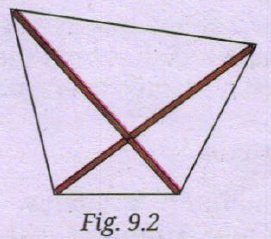
AIMS worked solution
Given
Construct a genuine quadrilateral of category Q by using two sticks as its diagonals. Compare (i) Q implies equal diagonals and (ii) equal diagonals imply Q.
To Find
Whether equal sticks are necessary or sufficient, and whether placement matters
Reasoning
An implication specifies one direction; its converse cannot be assumed.
Solution
(i)(a) Equal sticks are necessary: every Q quadrilateral has equal diagonals.
(i)(b) Equal lengths alone do not guarantee Q
placement may matter.
For instance, squares require more than equal diagonal lengths.
The supplied implication alone cannot settle which placements give Q.
(ii)(a) Equal sticks are sufficient: any genuine quadrilateral formed with those equal diagonals is Q.
They are not proved necessary by this implication.
(ii)(b) No further placement restriction for Q follows once equal sticks form the diagonals of a genuine quadrilateral.
Coincident endpoints or a collapsed figure must be excluded.
Result
(i) Equal diagonals are necessary, not established as sufficient. (ii) They are sufficient, not established as necessary.
Compare the reasoning with your own work. Reading a solution does not record mastery.